I’ve sat in architecture reviews that spent four weeks arguing over if they should use Databricks or Fabric.
Slide decks were presented, vendor benchmarks were dissected. Execs weighed in and tempers flared.
Then, six weeks post a decision and contract, an infrastructure engineer created a 30 day lifecycle expiration on an S3 bucket that was being used for a external delta table. The infra person thought that it was holding transient “temp” files.
Over a single weekend two years of historical data was deleted.
Not one person brought up storage retention in the architecture reviews… Not once.
That is why I’m writing this article this week. That is the Architecture Review Board Inversion.
Engineering teams routinely spend months of political capital debating low-blast-radius, easily reversible decisions, while sleepwalking past the silent operational traps that permanently destroy corporate data.
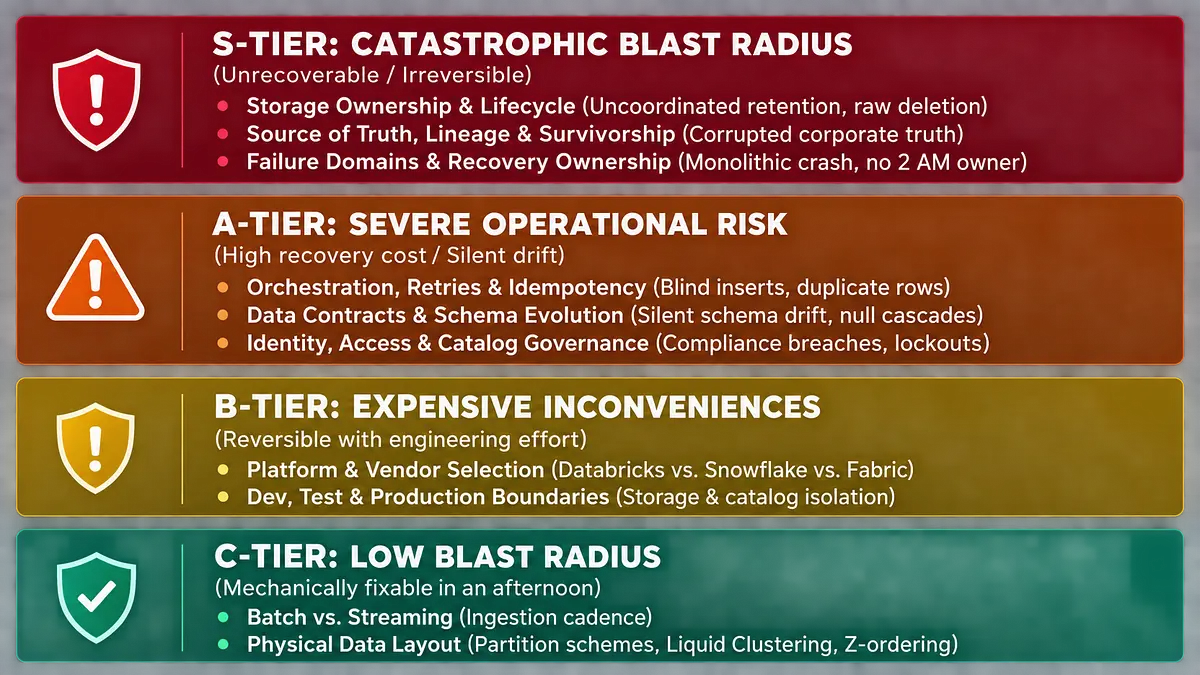
In my latest video, I Ranked 10 Data Architecture Decisions: From Low Risk to Production Nightmare, I placed 10 common data architecture choices into a tier list from C-tier (low risk) to S-tier (catastrophic production nightmares).
Today, I want to unpack the architectural mechanics behind this ranking, why standard governance reviews fail to catch these traps, and how you can run an audit on your own platform this week.
The Evaluation Matrix: Reversibility vs. Blast Radius
Architecture isn’t defined by how your stack runs on the happy path. It’s defined by what happens when a pipeline fails at 3 am.
When you’re evaluating production risk, there are only two metrics that truly matter.
Reversibility: How many engineering hours and dollars does it take to unwind the decision if the requirements change?
Blast radius: If the decision fails catastrophically, does it slow down a query, or does it permanently corrupt your financial records and wipe out your storage?
Here’s how the ten common architecture decisions actually shake out when you’re viewing it through this lens.
The Low Risk Distractions: Why C-Tier and B-Tier Consume Your Time
Leadership teams end up treating platform selection and ingestion cadence like existential corporate crises. They’re not!
Batch vs. Streaming (C-Tier):
Teams spend weeks debating whether a pipeline should stream continuously or run in batches. In modern lakehouse engines, structured streaming and scheduled micro-batches share virtually the same underlying codebase. If a team spins up an always-on cluster to stream website events into a dashboard that leadership only reviews on Monday morning, you haven’t added any value to the business. You just created an inflated compute bill.Physical data layout (C-Tier):
Bad partitioning hurts performance. If an engineer ends up partitioning a Delta table by a high-cardinality column like customer ID, you end up with half a million tiny directories in cloud storage. Queries end up slowing to a crawl, and compute bills go through the roof. It’s painful, but it rarely corrupts data. Reversing it is mechanical: you alter the table to use liquid clustering or run an optimize compact script, and your business logic remains untouched.Platform and vendor selection (B-Tier):
Choosing between Databricks, Snowflake, or Fabric carries immense political weight, and migrating off a platform is undeniably expensive. It burns calendar quarters, developer hours, and finance dollars, but if you adhere to open storage formats (ex. Delta Lake or Iceberg) and maintain modular SQL and Python logic, then switching vendors is an inconvenience, not a complete refactor. Your core data assets survive.
Platform choice only jumps to an S-tier if you lock your organization into proprietary storage formats and closed procedural code, where extracting your own historical data requires a fishing expedition.
The Three S-Tier Catastrophes That Break Data Teams
When enterprise platforms fail catastrophically, it’s never because someone actually chose a wrong clustering key (though that does present problems). It’s actually because foundational operational boundaries got ignored during those ARBs.
S-Tier 1: Storage Ownership and Lifecycle Policies
This is where true production nightmares are born.
Delta Lake, Iceberg, and modern lakehouse engines maintain your transactional state inside of catalog metadata and transaction logs. Cloud providers maintain all of your raw object state via bucket lifecycle rules, and when those two systems aren’t synchronized, that’s when issues occur.
If an infrastructure team applies a 30-day lifecycle expiration policy to an S3 bucket or ADLS container holding external tables, then the cloud provider is going to silently delete all your underlying Parquet files while transaction logs are still expecting them to exist. The moment that query hits that table, you’re going to get a missing file exception and probably spend hours or even days troubleshooting why.
Similarly, running an aggressive vacuum with 0 hours of retention on active external storage wipes files referenced by your concurrent transactions.
Once your raw objects are purged from cloud storage, time travel’s gone. There’s no DeLorean that’s coming to save you. Your snapshots are gone, and the data can’t be queried or restored. Your blast radius is permanent, irreversible data loss.
S-Tier 2: Source of Truth, Lineage and Survivorship
Fixing a syntax error or broken joins takes minutes. Fixing corrupted corporate truth and trust takes months!
When two operational systems end up writing conflicting updates to the same customer entity and your survivorship rules are ambiguous, your data platform ceases to be trustworthy.
Consider this example: a CRM migration is running in parallel with a legacy billing system. Both are feeding updates into your lakehouse. Address updates start to overwrite each other based on ingestion order instead of authoritative business rules. Invoices start bouncing. Statements are shipped to the wrong addresses, and all of a sudden, your receivables start to stall, and your business is struggling to meet its payment obligations because revenue isn’t coming in.
This may sound like an extreme example, but I’ve seen it happen, and this is where you truly start to understand how data teams make or break businesses.
Once business stakeholders start to lose confidence in your gold layer numbers, the data platform is dead in the water. Recovery requires months of research because nobody can prove which historical state was authentic, and your data teams end up spending their time defending their numbers instead of truly moving the business forward.
S-Tier 3: Failure Domains and Recovery Ownership
Architecture is defined by your blast walls.
If you have an enterprise that’s running on a monolithic shared catalog or a single shared compute cluster across every department, an ad hoc, unoptimized query executed by an intern in marketing ends up triggering out-of-memory crashes that halt all ETL, production, and regulatory reporting pipelines simultaneously.
And worse than the technical outage is the operational finger-pointing. When everything is failing, who owns the recovery, and ultimately, who’s responsible?
If recovery ownership is undefined, then teams end up spending 12 hours pointing fingers across Teams messages while the company is bleeding revenue. Without isolated failure domains and explicit operational owners, your data architecture becomes a liability.
The 5-Point Architecture Blast-Radius Self-Audit
Before your team sits down for another two-hour debate about vendor features or pipeline syntax, walk through this 5-point audit on your current production environment:
Storage Expiration Audit: Do your cloud infrastructure buckets (S3/ADLS/GCS) have any automated lifecycle policies, object expirations, or retention rules operating independently of your Lakehouse catalog metadata?
Idempotency Verification: If your core ingestion workflows fail halfway through and automatically retry three times, does your pipeline execute an atomic merge/overwrite, or will it append duplicate rows into downstream tables?
Schema Evolution Quarantine: If an upstream engineering team changes a key status field from an integer to a string at 4:30 PM on Friday, does your pipeline fail safely into a dead-letter quarantine table, or does it silently ingest null values across the weekend?
Authoritative Survivorship Rules: For your core business entities (customers, accounts, orders), is there an explicit, documented rule defining which operational system wins in a conflict, or does the latest write blindly overwrite the record?
Blast Wall Isolation: If your primary development or analytics workspace experiences a complete outage right now, can your core production data pipelines and customer-facing deliverables still run uninterrupted?
Strategy > Syntax
Stop letting your architecture discussions get hijacked by low-risk syntax and vendor debates.
Look at your failure domains. Audit your cloud storage lifecycle rules. Establish explicit data contracts and unambiguous survivorship policies. Make the architecture decisions that protect your company when things go sideways.
Make the data decision you can defend six months from now.
Watch the Video Breakdown
For the full analysis and examples behind all 10 architecture rankings, watch the complete video: I Ranked 10 Data Architecture Decisions: From Low Risk to Production Nightmare.
Need an Objective Review of Your Architecture?
If you are currently evaluating a platform migration, untangling Unity Catalog governance, or trying to de-risk an enterprise Lakehouse environment before heading into production, let’s talk.
You can book a 30-minute Strategy & Architecture Fit Call directly with me. We will look at what is driving the actual risk in your platform and map out a practical next step.
Chris Gambill
Founder & Principal Architect, Gambill Data, LLC
Strategy > Syntax
Related decision support
Data architecture consulting
Review storage ownership, lineage, and failure domains before an irreversible decision slips through unexamined.
Review the service