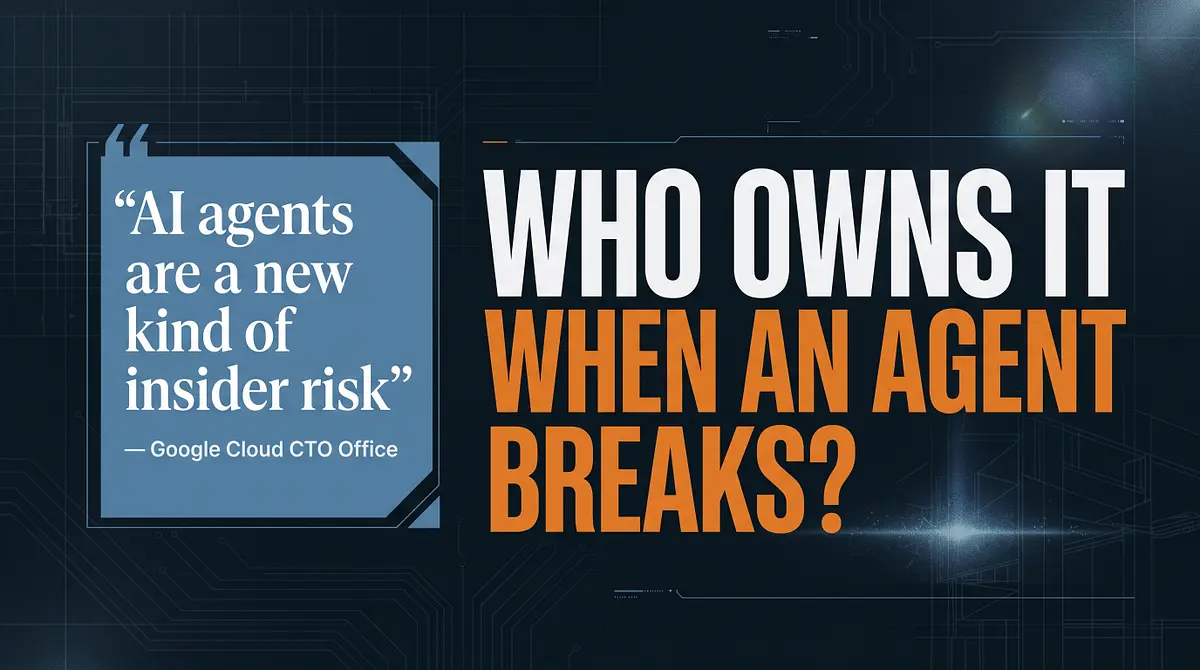
A recent dispatch from Google Cloud’s Office of the CTO called AI agents a new kind of insider risk.
Read that again.
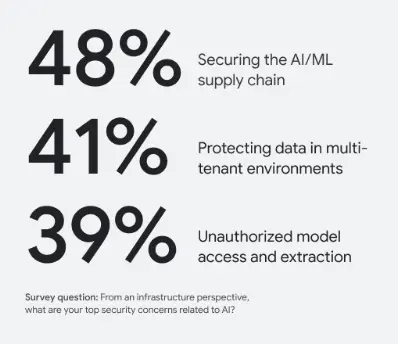
Google builds these models. They sell the infrastructure. They are currently engineering an enterprise control plane designed to coordinate hundreds of millions of registered agents.
When the vendor building the runtime substrate warns you that autonomous agents pose an insider threat to your enterprise, you should listen.
They aren’t saying agents are a toy that will fail. They’re telling you that agents will work well enough that companies will deploy millions of them. Within two to three years, your company could easily have more autonomous software agents running across your internal networks than human employees on payroll.
If you lead engineering, data, or architecture, this wave will hit your desk faster than your governance roadmap anticipates.
And underneath the hype, vendor keynotes, and proof-of-concept demos sits one uncomfortably blunt operational question:
Who owns it when an agent gets it wrong?
If your organization can’t name the specific human who answers for that agent’s decisions, you aren’t ready to deploy your next agent.
The Prototype Mirage: Why Friday Demos Kill Monday Operations
Getting your first AI agent working feels like crossing the finish line.
You wire an LLM to a vector store or a SQL table. You hook it up to a webhook in Slack. You ask it to pull customer churn figures or summarize recent support tickets. A clean, articulate response lands in the channel within three seconds.
The executive team applauds. The project sponsor declares victory. Everyone pops champagne on Friday afternoon.
Building that demo was just syntax. Living with the operational side effects in production is where the real bill comes due.
In 25+ years leading enterprise data architecture, I’ve watched this movie play out across every wave of technology:
In 1999, it was unmonitored SQL Server DTS packages running raw bulk inserts across production transactional databases.
In 2008, it was sprawling SSIS workflows running on elevated domain service accounts that nobody documented.
In 2016, it was fragile PySpark notebooks on unpartitioned clusters failing at 3:00 AM because an upstream vendor added a single nullable column.
In every case, the technology didn’t fail because the code crashed. The initiative failed because nobody defined operational boundaries, runbooks, or blast radius.
Now, we’re doing it with autonomous agents. Except agents don’t behave like traditional software.
A traditional microservice runs a deterministic code path. A request arrives, the service executes predefined logic, and a response returns 50 milliseconds later.
Agents do not do that.
They query external tools. They pause on asynchronous inputs. They branch based on probabilistic weights. They loop through reasoning steps until they convince themselves the task is complete.
Most critically: an agent isn’t passive read-only software.
An agent holds API keys. It carries database credentials. It has permission to modify records, trigger workflows, route support requests, and commit financial spend.
When you let decentralized teams spin up autonomous agents without central oversight, you don’t get digital transformation. You get unmonitored agent sprawl.
Who built that customer refund agent? What tables did it read? What records did it overwrite last Tuesday?
When something goes sideways, who is responsible?
When Status 200 Means Disaster: A Lived Experience from the Trenches
Let me give you a concrete example from my consulting work where the technology worked without a single error, yet the absence of architectural ownership created an enterprise disaster.
An enterprise client brought me in to untangle their core master data tier.
They had two separate CRM instances and an ERP platform feeding updates into a central customer data hub. The engineering team had built automated sync pipelines to keep customer profiles uniform across departments.
Technically, the integration pipelines were flawless:
The APIs responded with HTTP status 200 OK.
The payloads validated against the schema.
The jobs completed green on the orchestration dashboard every morning.
Yet underneath that clean dashboard, a silent logic deficit was silently destroying the platform.
Nobody had established source system priority. Nobody had negotiated strict data contracts.
One of the secondary CRMs began passing blank tax identification numbers and outdated billing addresses for enterprise accounts. Because the pipeline had write permissions and never crashed, it quietly overwrote verified, golden records with null fields and garbage data.
The corruption sat undetected in production for weeks.
It wasn’t caught by automated monitoring. It was caught when quarterly billing went out, invoices bounced across major client accounts, and the CFO escalated the issue directly to the executive committee.
The software didn’t fail. Ownership failed.
Nobody had defined which system was authoritative. Nobody was auditing the quality of business decisions. Nobody held the pager for data fidelity.
If you let autonomous agents alter your production environments without strict contracts and bounded blast radiuses, you will recreate that exact disaster at ten times the speed.
The 5 Questions Every CTO Must Settle Before Deploying an Agent
Google is currently spending hundreds of millions of dollars building runtime substrates, state engines, and message brokers to coordinate fleets of agents.
Plumbing gets agents running. Whether they run responsibly is an architecture problem that vendor tooling can’t solve for you.
Here are the five questions I require every client to answer before a single agent receives production credentials:
1. What measurable business outcome does the agent actually own?
If your answer is a technical task (like “it monitors inbox threads” or “it runs SQL queries against Databricks”), you don’t have an owner. You have an uncontrolled script.
An agent must be tied to a defined, verifiable business deliverable with concrete acceptance criteria.
2. What can it read, decide, change, or spend?
Define the blast radius before you generate API keys.
If an agent has write access, limit its scope programmatically. Can it alter tables, or can it only stage proposals for review? Can it commit dollars, and if so, what is the hard programmatic ceiling per transaction and per day?
Giving an autonomous agent unrestricted service account credentials into your production Lakehouse or CRM is operational negligence.
3. At what boundary condition does it hand off to a human?
The moment an agent’s confidence score drops below a verified threshold, or when an input falls outside anticipated edge boundaries, the execution loop must halt.
It must route the decision directly to a human domain specialist with full contextual lineage. “When in doubt, guess and proceed” is acceptable in a weekend hackathon. In an enterprise data platform, it is fatal.
4. What evidence proves it is still doing the job correctly?
A status 200 OK from an LLM endpoint means only that the server returned tokens. It tells you zero about whether the output is truthful, compliant, or destructive.
You need automated evaluation harnesses, continuous regression testing against golden benchmark datasets, and auditable lineage. You must verify that the quality of the decisions lives up to production standards week after week.
5. Who owns the consequence when it fails?
This is the question engineering teams skip every time.
An algorithm can’t get fired. A prompt can’t sit across the desk from an internal auditor or a compliance regulator.
In my Databricks FinOps audits, I enforce a non-negotiable rule: if a cloud compute workload does not have a verified, named human owner tag attached to it, it is not permitted to spin up a single cluster.
The exact same standard applies to AI agents.
If you can’t name the specific human leader who signs off on the agent’s decisions and takes personal accountability when it breaks, that agent does not belong in your production environment.
Your Weekly Mission: The 60-Minute Agent Audit
If your team is already experimenting with or deploying autonomous agents, run this quick drill before Friday:
Inventory the Credentials: List every agent currently operating in your staging or production environments. Document what databases, APIs, and cloud resources each service account can access.
Cap the Blast Radius: Restrict every agent’s write permissions. If an agent only needs to analyze data, strip its update and delete privileges immediately.
Audit the Monitoring: Review your logs. Are you only monitoring whether the API call succeeded, or are you validating the business logic and output drift?
Identify the Human in the Loop: Define the explicit boundary where the agent must stop and hand execution over to an engineer or operator.
Assign the Named Owner: Put a real human name next to every agent running in production. If an engineer or manager refuses to attach their name to its operational outcomes, decommission the agent until someone will.
Make the Decision You Can Defend Six Months from Now
Speed to syntax has never been cheaper. Any junior engineer with an IDE and an API key can cobble together an agentic workflow in an afternoon.
Building architectures that survive production, protect enterprise data assets, and defend business margins is still the job.
Google isn’t preparing for agents to disappear. They’re preparing for an enterprise ecosystem flooded with millions of them.
Build the governance, evaluation, and ownership layer today, before scale forces you to do it in the middle of an audit crisis.
Strategy beats syntax. Every single time.
Chris Gambill
Founder & Principal Architect, Gambill Data, LLC
Advising enterprise data leaders on Lakehouse architecture, FinOps discipline, and production resilience.
Watch the Breakdown: Watch the full 8-minute deep dive on YouTube
Book a Fit Call: If you are navigating Databricks Lakehouse architecture, Unity Catalog governance, or AI platform strategy, book a 30-minute Strategy & Architecture Fit Call
Join the Accelerator: For engineers ready to stop doing tutorial cosplay and master production-grade lakehouse engineering, explore the Data Engineering Accelerator
Related decision support
AI readiness assessment
Test whether ownership, permissions, monitoring, and operating controls can support autonomous agents in production.
Review the service