Your entire value lies in writing python and memorizing SQL syntax.
That’s the lie that businesses tell their data engineers. Even if you haven’t heard those words you feel it when you write something that automates a task that used to take a day per week for your COO’s admin to pull together.
Now every vendor video on YouTube makes the same promise: an AI agent reads your source data and is automating you out of your job that you have invested time away from your wife and kids to grow into.
Then that same AI agent will end up meeting real enterprise data. (Real messy enterprise data).
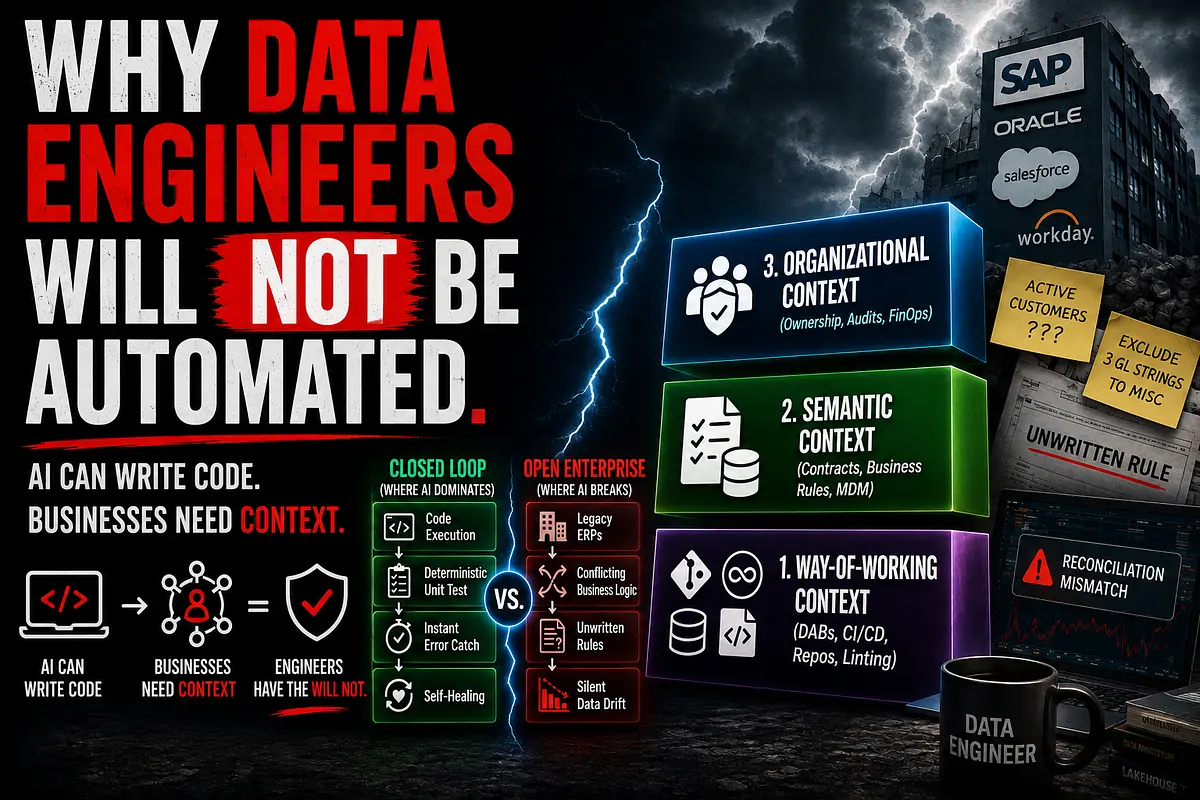
It hits that 15 year old SAP ERP instance with unexpected German headers, 3 VPs with different values and definitions of “active customers”, and a unwritten rule in finance that excludes 3 GL strings from customer service and moves them to “misc”.
The agent generated code that is technically perfect, except for the fact that it produces reports that conflict with monthly reconciliation report from that finance analyst and funnel values from your sales leaders.
If this sounds familiar, it should, it is the reason (one of many) why data engineers exist, and why they will continue to.
Close Loops vs The Distributed Enterprise
To understand why LLMs struggle in enterprise data, let’s take a look at where AI actually excels: closed-loop systems.
A closed-loop system is deterministic. It has isolated environments and instant feedback. Think about your Leetcode that you shouldn’t be spending as much time on. Your standalone Python parsers. Your single-function unit tests. In a closed loop, an AI agent can write code, run the test, catch the error, and self-heal in seconds.
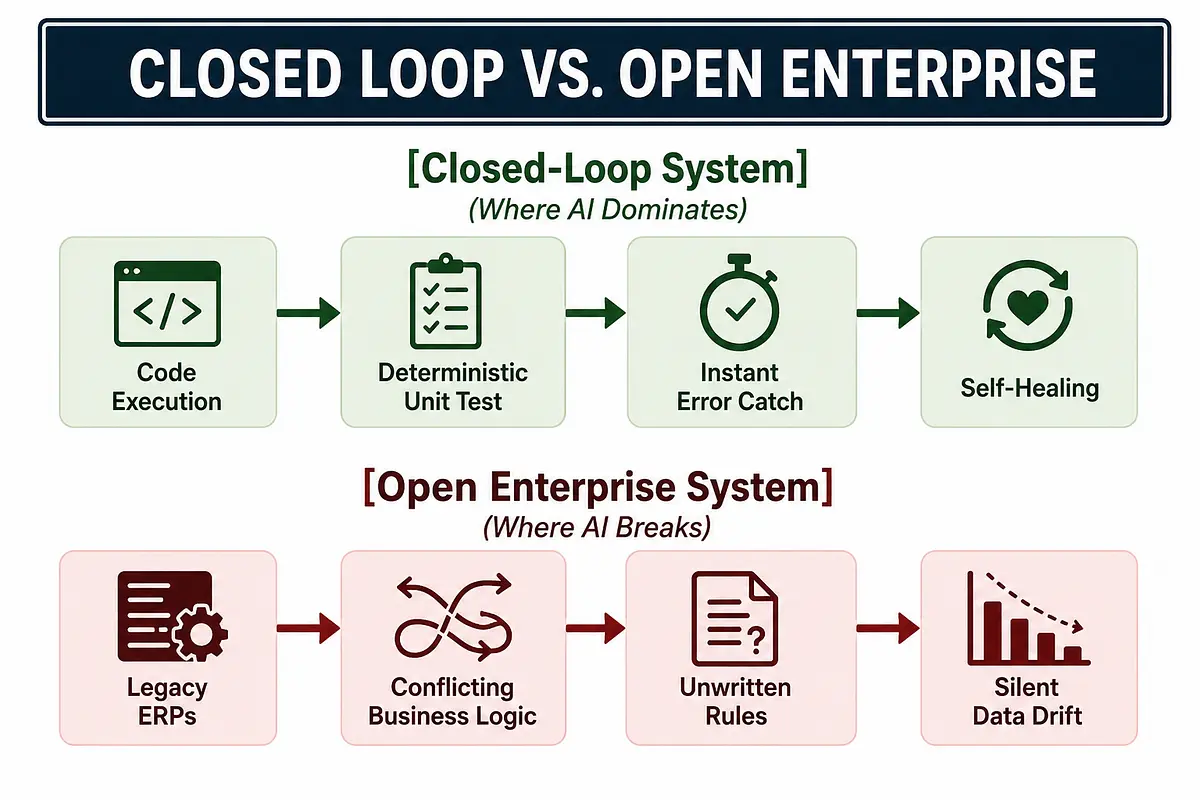
Enterprise Data Engineering is an open distributed system. It doesn’t fail because of bad syntax. It fails because you have missing context.
Upstream Chaos: this is when a third-party SaaS vendor silently alters an API payload on Friday afternoon, and you end up working all weekend to fix it.
Semantic Divergence: this is when finance calculates MRR on cash collected. Product calculates MRR on active licenses, and both are correct inside of their own parts of the business.
Regulatory Boundaries: These are PII masking rules that change depending on whether data is queried from the EU or the US.
Recently, Anthropic submitted a research paper evaluating LLM reasoning. Researchers found that the model performance hits a hard ceiling when now getting ambiguous environments. The variable that caused the evaluation scores to actually increase wasn’t bigger model weights or longer compute times. It was human-in-the-loop context injection.
When a human person supplies structured organizational constraints and domain boundaries, AI goes from brittle hallucinations to production assets.
The Three Layers of Enterprise Context
So, you want to build systems that AI can actually help you accelerate. First, you’re going to have to separate context into three different architectural layers.
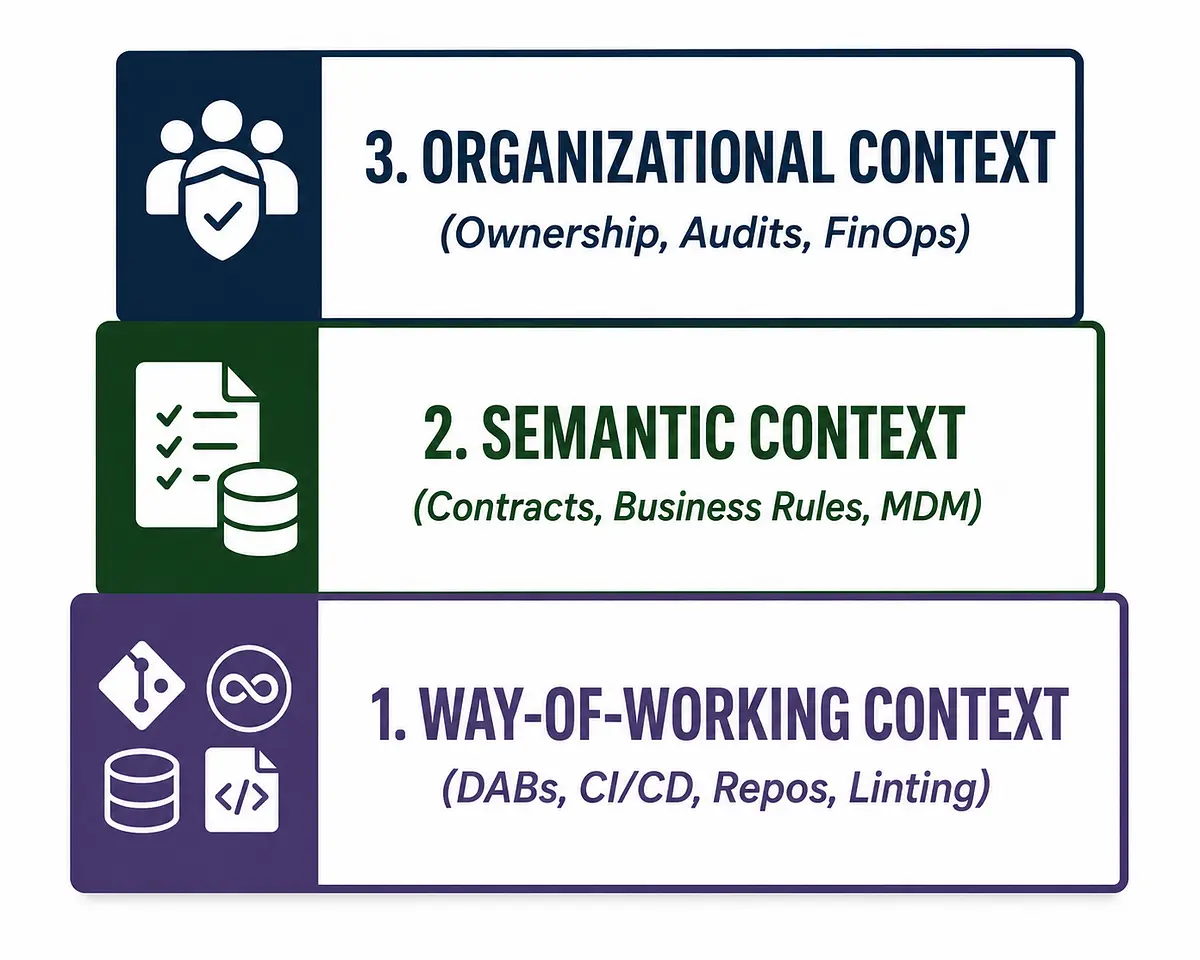
The Way of Working Context (Operational Layer):
This is your baseline engineering discipline. You have repo structures, branch protection, DABs, IaC, and automated CI/CD deployment pipelines.Domain & Semantic Context (Definition Layer):
This is where your data platform battles are won or lost. An LLM doesn’t know when status ID equals 4 that an order is technically canceled only if the refund timestamp is populated. If you don’t define these invariants using tools like Unity catalog data contracts, delta table constraints, or pydantic validation schemas, AI will generate pipelines that silently poison your gold layer because it doesn’t understand your business!
Organizational & Political Context (Governance Layer):
Who owns the failure when a pipeline breaks? I’ll give you a hint: it’s not the AI! What is the fine ops budget threshold before a cross-train spin-up gets throttled? How do we balance CFO compute limits against executive dashboard latency? All of this context doesn’t exist in any GitHub repo or database catalog. It lives in leadership alignment, business stakeholder interviews, and cross-functional negotiation.
26 Years, Same Lesson: .dts to Lakehouse
Over 26 years in the industry, and I’ve watched this exact cycle repeat:
In the late 1990s and early 2000s, graphical ETL tools like DTS packages and drag-and-drop SSIS were supposed to eliminate database developers.
In the 2010s, Hadoop and cloud warehousing were supposed to come in and automate schema design. Have you seen that big yellow elephant around lately?
Today, LLMs and declarative engines like Databricks LakeFlow are supposed to make data engineers obsolete.
In each of these eras, the abstraction layer moved up, boilerplate typing dropped, and the demand for architectural judgment increased.
By using AI assistance like Cursor or Omnigent on top of Databricks, you’re not stopping thinking. It just means that you stop wasting four hours writing boilerplate ingestion loops, so you can spend four hours designing deterministic data contracts, optimizing DBU compute costs via liquid clustering, and securing your Lakehouse.
Weekly Mission: Are you dictating or architecting?
Here is your weekly mission. Audit your current workflow.
Are your business rules written down and coded, or are they stuck in somebody’s head? If your pipeline logic only exists in your head or the head of your lead that’s a year and a half from retirement, an AI agent can’t assist you safely. Be sure that you are coding those invariants into your data contracts!
Are you relying on closed-loop code tests? Don’t test your pipelines by running ad hoc queries in production workspaces! Be sure that you are enforcing automated schema and data quality expectations via something like LakeFlow Expectations, the DQX library, or dbt.
Do you know your FinOps unit economics? Can you defend the DBU compute bill of your pipelines to your VP? If you can’t explain why a job took 230 seconds versus 22 seconds due to data skew, AI is only going to help you waste money quicker.
Are you closing the loop with modern protocols? Explore how MCP servers can connect LLMs directly to your catalog metadata, allowing agents to read the schemas without granting unmonitored write access.
Does your work solve a business use case or just write code? If your daily update is “I finished five notebooks today,” you’re the one that’s vulnerable. If your update is “I reduced ingestion latency by 40 and eliminated duplicate customer records across two of our ERP systems,” your seat at the table isn’t going away!
Strategy > Syntax
AI isn’t taking your job. An engineer who understands how to feed structured business context into AI systems will comfortably outpace an engineer who refuses to adapt. Stop defining your worth by how fast your fingers can type syntax. Start defining your worth by how defensible your architecture is when production really hits the fan.
Make the data decision that you can defend six months from now.
Resources & Next Steps
Level Up Your Career: Ready to move past tutorial hell and build production-grade, SOW-style data lakehouse projects that hiring managers respect? Explore the Gambill Data Coaching Program.
Enterprise Advisory: If your team is struggling with runaway Databricks DBU bills, messy Unity Catalog governance, or migrating to Lakeflow pipelines, book an Architecture Discovery Call.