
A Director of Data and Analytics at a Fortune 500 client recently admitted something to me during an architecture audit.
“We throw away about 90% of our junior and mid-level data engineering resumes before they even hit the phone screen.”
But why was that? Well, because most candidates aren’t presenting proof of production readiness. They’re presenting tool cosplay!
Kaggle notebook here, a Titanic CSV cleanup there, maybe a GitHub repo with a two-sentence README, or worse, one with about 300 different emojis in it. Doesn’t prove that you can manage enterprise data platforms. It shows that you can follow video tutorials.
If you want to break out of Tutorial Hell and land senior roles, or defend your seat in the age of AI coding tools, you need to demonstrate real engineering judgment.
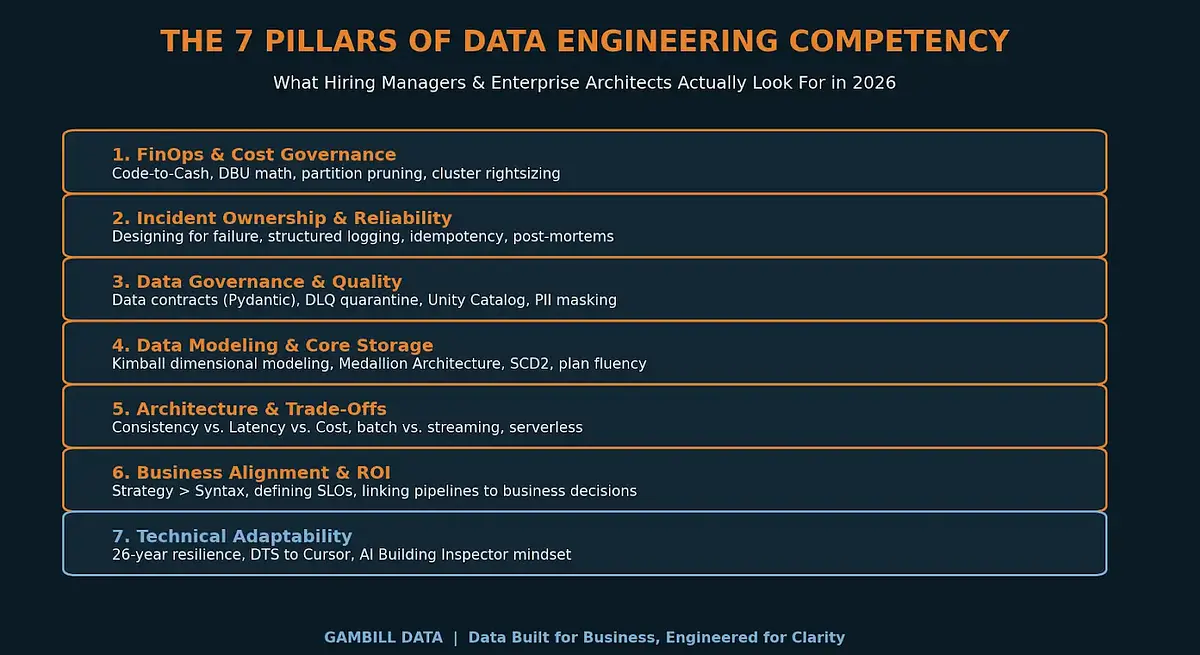
1. FinOps & Cost Governance (Code-to-Cash)
Technical elegance is worthless if you end up running up a $50,000 unexpected compute bill. In a multi-tenant cloud environment, code that just works can still be a financial liability.
So what does this pillar actually prove? It proves that you treat your cloud compute as real money and business impact.
Here’s the bar:
You don’t just write PySpark or SQL. You can explain partition pruning, liquid clustering, warehouse right sizing, and automated data retention policies.
You actually connect query performance directly to dollars saved and business outcomes!
2. Incident Ownership & Operational Reliability
Senior engineers don’t write code for the happy path. They write code for those moments that they have to wake up at 3 a.m. when production emergencies hit because a pipeline failed.
What this pillar actually proves is how you design for the inevitable system failures rather than hiding from them.
Here’s the bar:
You stop building logic in blanket try-accept blocks that swallow your errors.
You implement structured logging.
You put in CI/CD test gates.
You add in idempotent processing,
and you are doing post-mortems when things fail or break.
3. Data Governance & Quality Guardrails
Bad data corrupts downstream dashboards, weaponizes AI models, and deteriorates business trust. Treating data quality as a chore is why stakeholders stop trusting reports.
Here’s what this one proves: proves that you act as a gatekeeper against bad data from entering your lakehouse.
So here’s the bar:
You’re building declarative data contracts using Pydantic or Great Expectations.
You are routing bad records to dead letter queues.
You’re enforcing PII masking,
and you’re managing access across your Unity Catalog or Fabric.
4. Data Modeling & Core Storage Architecture
Tooling changes all the time, but solid data modeling remains the foundation of data engineering high-performance analytics.
Here’s what this proves: you understand how to structure storage for query speed, auditability, and long-term scale.
Here’s the bar:
You’ve mastered dimensional modeling.
You know how to implement medallion architecture.
You have a clear understanding of slowly changing dimensions and which one to use when.
You understand how to look at SQL execution plans so that you can eliminate things like table reads and network shuffles.
5. System Architecture & Trade-Off Fluency
Freshers end up picking tools based on hype. Senior architects pick tools based on system constraints and team skills.
This pillar proves that you can evaluate technical decisions using business realities instead of just hyped up vendor marketing.
And here’s the bar: You can state design trade-offs in one clear sentence.
Consistency vs availability vs latency vs cost
When batch processing meets streaming
When external tables are better than managed tables
When to use serverless compute vs managed clusters
6. Business Alignment & Decision Support (Strategy > Syntax)
For those of you that have been reading, you know that I love this pillar: strategy over syntax! If you can’t link your pipeline to a business decision, then you’re a cost center instead of a strategic asset.
This pillar proves that you can build data platforms that truly help businesses move forward or move the needle, if you want to use the current business term.
And here’s the bar.
You can define clear service level objectives with your business stakeholders. You measure success by time saved, risk mitigated, or revenue protected, not just row counts processed.
7. Technical Adaptability & Architectural Resilience
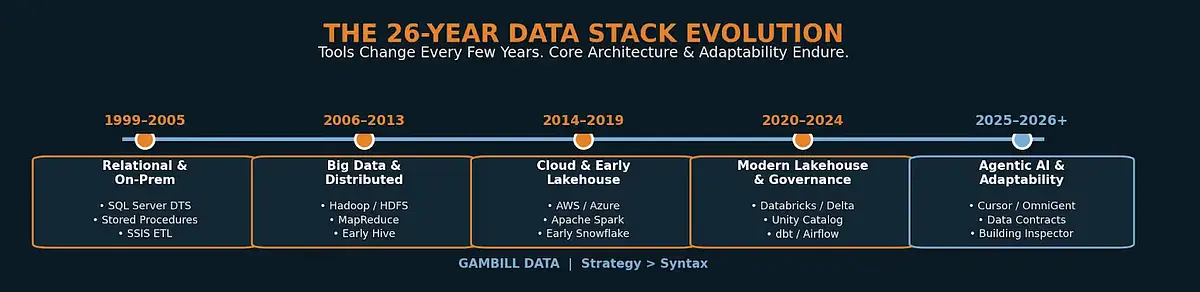
Tools and syntaxes end up depreciating rapidly, but foundational architecture principles remain constant across technology cycles.
This one is actually so important, and it proves that you possess the foundational principles required to navigate technology shifts over time instead of anchoring your career to a single tool platform or syntax.
And here’s the bar here. You are able to transition across technology eras from legacy ETL to Hadoop to modern cloud lakehouses and AI coding assistance, like Cursor or Omnigent. You can do all of this without losing any of your operational control. You’re able to leverage AI to accelerate delivery and still act as the building inspector who is auditing your execution plans, your security card rails, and your cost applications.
Your Mission… Should you choose to accept it
The Portfolio Audit
I want you to take 30 minutes this week and review your current projects and your resume bullet points. Run it through this gauntlet!
Kill the generic projects: Replace Kaggle/Titanic dashboards with custom, problem-driven architectures.
Add a FinOps metric: Show how you reduced scan volumes or optimized cluster compute time.
Include a “Post-Mortem”: Document a pipeline failure, why it happened, and how you engineered the fix.
Enforce a Data Contract: Show how bad data gets quarantined before reaching Gold tables.
Update your README: Write your project documentation like an enterprise handoff spec, explaining the business context and architectural trade-offs.
Now, build proof that gets you hired!
If this is making you question where you currently stand: or whether your current skills are preparing you for where data engineering is heading: you can book a no-obligation coaching fit call with me.
We’ll look at your career direction, your technical judgment, and the next capability you need to build.