If your portfolio is full of projects that you completed during boot camps, Udemy courses, and Coursera projects, that’s exactly why you aren’t getting any callbacks!
In my 26 years of being in data and interviewing candidates and choosing candidates for various data positions, I’ve never once looked at a portfolio project for any other reason than that it intrigued me or it was a problem I was currently having.

Hiring managers aren’t rejecting your application because it doesn’t have a GitHub link.
They’re rejecting it because your repository screams “liability!”
If your portfolio consists of downloaded CSP files, local Python scripts, and generic group-by transformations, you’re telling hiring managers that you have never had to manage cloud compute bills, API drift, or any type of decision framework.
That’s why today I’m going to break down an actual production-grade portfolio project built by an engineer in my coaching program. He bypassed the toy datasets, connected directly to federal and state APIs, and engineered a Databricks Medallion Lakehouse to solve a multimillion-dollar healthcare expansion problem across all 9,100 census tracts in California.
I’m going to tell you the exact architectural blueprint, why hiring managers care, and how you can apply this same framework to stand out immediately in your job search.
The Core Business Problem: Location Intelligence vs Tool Cosplay
Healthcare systems don’t drop $50 million facilities wherever they feel like it. They require data-backed location intelligence to deploy capital where medical coverage gaps and viable land intersect.
To do this properly, you can’t muddle through static spreadsheets in Excel or run new queries against transactional databases. You have to evaluate sub-county units called MSSAs (or Medical Service Study Areas), the federal standard used to designate Health Professional Shortage Areas (HPSAs).
An enterprise healthcare network expanding its footprint needs to answer four stakeholder questions simultaneously:
Chronic health burden: What are the highest concentrations of chronic disease?
Socioeconomic barriers: Which tracts face acute poverty and low vehicle access?
Existing coverage: Where are the active health resources and service administration clinics currently operating?
Site feasibility: Is there viable, build-ready public land or open space available in those exact target pockets?
If an engineer attempts to tie this together using unoptimized raw queries, they end up crashing reporting tools. They trigger massive memory spills, burn through thousands of dollars in wasted compute, and just end up spinning their wheels.
You need a centralized lakehouse architecture built for scale!
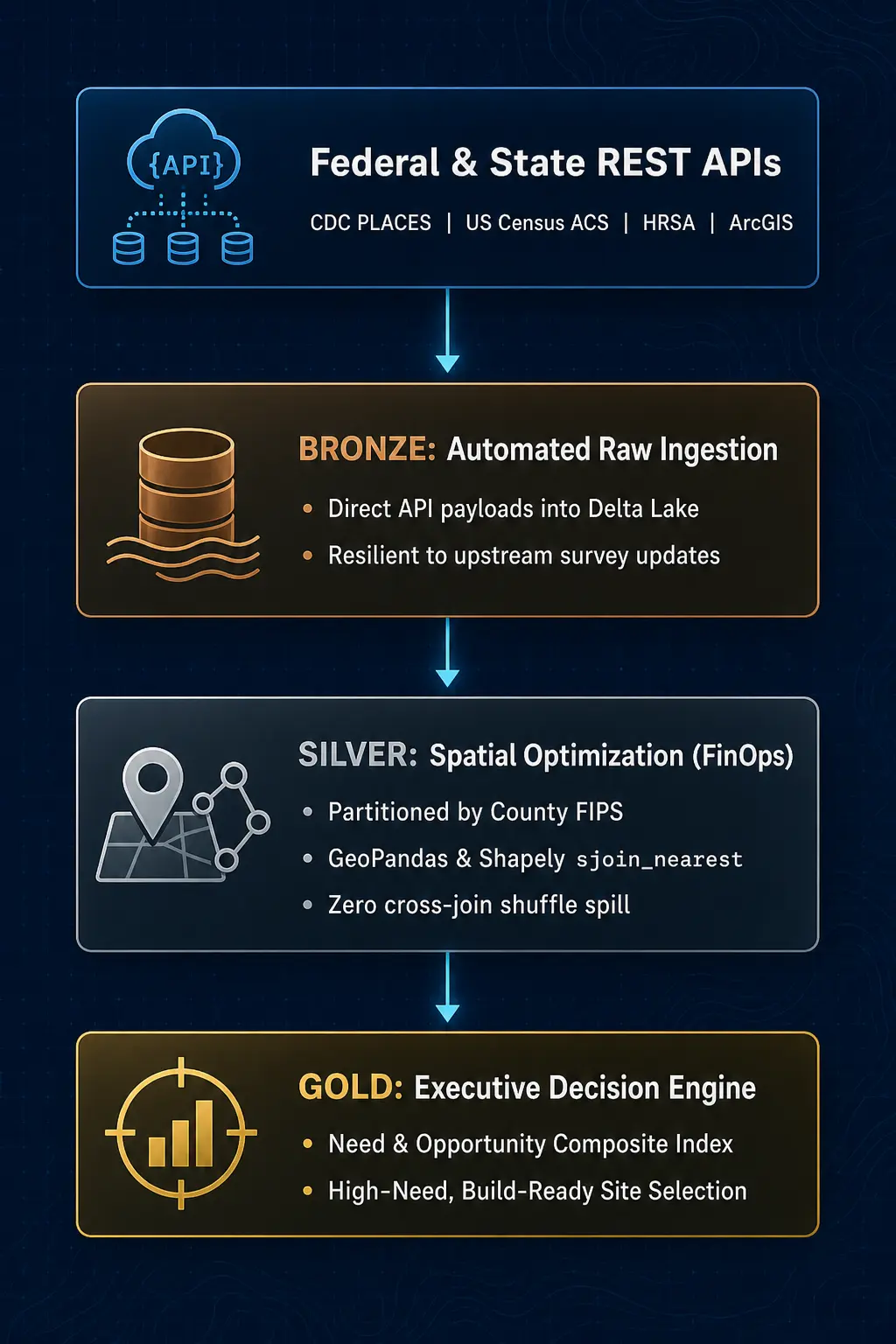
The Technical Architecture: Engineering the Medallion
Here is how the pipeline was engineered inside of Databricks using Delta Lake, PySpark, and spatial indexing.
Pillar 1: Automated Bronze Ingestion (No desktop CSVs - This isn’t a toy project)
Rule number one of production data engineering: stop downloading static CSVs to your local machine! This pipeline connects directly to live federal and state REST endpoints.
CDC Places API: This one is census tract-level chronic disease prevalence and health outcomes.
U.S. Census Bureau API: This is the 2024 ACS 5-year socioeconomic and demographic tables.
HRSA Health Sites Registry: These are the geospatial coordinates of federally qualified health centers.
The California Open Space/ArcGIS REST layers: These are complex land parcel polygon geometries.
These are the raw payloads that we’re going to write directly into the bronze development tables. When the 2025 ACS survey drops or the HRSA registry updates, the pipeline reruns end-to-end without requiring downstream transformations to be refactored, implementing idempotency, API pagination, and parsing of JSON data into structured bronze tables.
Pillar 2: Silver Layer Spatial Optimization and FinOps
This is where 90% of you are failing your technical interviews.
In this project this coaching member used:
Demographic tables that are structured around census tract FIPS codes.
Health facilities that are point coordinates (lat and long).
Land parcels that are polygon geometries.
If we stopped there, we’d all be wondering: How do you join 100,000 clinic coordinates to 9,100+ polygon boundaries in PySpark without exploding your Databricks cluster compute bill? If you execute an unindexed spatial cross-join, these executor nodes will choke on memory shuffle and rack up massive DBU burn. What’s the engineering fix?
Partition the dataset at the county FIPS level prior to spatial computation.
Vectorize spatial joins.
Utilize GeoPandas and Shapely using `sjoin_nearest` within bounded county partitions to map coordinates to census boundaries.
Clean your Delta Silver tables.
Output queryable, schema-enforced Delta tables ready for analytical aggregation.
Pillar 3: Gold Layer Composite Opportunity Scoring
Now we have a bunch of tables, but your senior leadership isn’t going to care about those tables. They need an actionable decision framework.
That’s where the gold layer transforms our demographic distress, clinical isolation, and land availability into a unified opportunity index:
Mobility and economic stress: percentage of households with zero vehicle access combined with poverty rates
Disease burden: elevated chronic disease prevalence from CDC Places
Clinical isolation: calculated distance to the nearest existing HRSA facility
Development viability: proximity to viable, zoned public land parcels
The result is an executive-ready heat map ranking all 9,129 California census tracts by immediate strategic priority.
Pillar 4: Architectural Portability
The true test of enterprise architecture is portability because federal endpoints (the Census, CDC, HRSA) use standardized national schemas. This entire platform can be deployed for Texas, Florida, or the Great Lakes region simply by swapping out the state-level GIS boundary endpoints.
The 25-Year Reality Check: Strategy > Syntax
Over my 25+ years in data, I’ve seen the tooling undergo massive shifts.
I started with SQL Server .dts packages, migrated to SSIS, managed bare metal Hadoop clusters, built enterprise platforms in AWS and Azure, and now I help businesses design lakehouses on Databricks, all while leveraging AI development tools like Cursor and Omnigent.
The syntax changes every few years. The underlying architectural discipline doesn’t.
Hiring managers and consulting clients are not paying you to memorize syntax that an AI coding assistant can generate in 3 seconds.
They’re paying you to make the data decision that you could defend 6 months from now.
When you stop hiding behind those toy tutorials and demonstrate that you can take raw, messy public data, enforce FinOps discipline, and produce an executive decision asset, that’s when your resume stops getting filtered out.
The Weekly Self-Audit: Test Your Portfolio
Take an objective look at your current repositories or your team’s internal pipelines against these five production criteria.
Automated ingestion: Are you ingesting directly from live REST APIs with schema validation or relying on static files?
FinOps and partitioning: Do you structure partition keys, such as county FIPS, to eliminate executive memory spill and control your DBU burn?
Data contracts: Are your bronze-to-silver transitions resilient against upstream API changes?
Decision-grade output: Did you deliver a composite scoring index that answers an executive business question, or just dump raw counts?
Architectural defense: Can you defend every join strategy, cluster configuration, and data contract in a technical interview?
Watch The Full Breakdown
For the full walkthrough and a deeper look at the architectural choices made inside this project, watch the full video on YouTube: The Data Project That Actually Gets You Hired!
Find Mohammad's repo (transferred to my account for anonymity): https://github.com/cg1262/ca-public-health-facility
Ready to level up your data engineering capability?
For Data Engineers & Architects: Move past tutorial hell and build enterprise-grade Databricks platforms that command attention in the Gambill Data Coaching Program.
For Enterprise Leaders: Eliminate runaway compute bills, resolve pipeline bottlenecks, and enforce Unity Catalog governance with a fixed-price Databricks Lakehouse & Unity Catalog Audit.