The AI hype cycle is still in mid-gear. While the pundits argue over whether AI is a bubble, I am looking at your commit history (yes you!) and seeing a problem. The era of the “code monkey” or the engineer whose primary value proposition is writing boilerplate Python or clicking buttons in a GUI to move data from Point A to Point B is over.
If that is all you do, you have already been replaced. You just haven’t been fired yet.

We are currently in a dangerous career window where the “middle skill” engineer is getting absolutely wiped out by automation and budget constraints. The juniors are using AI to punch above their weight. The seniors are using AI to architect complex systems faster. But the middle? The engineers who know the syntax but lack the judgment to design for failure? They are bleeding value.
I do not care about “happy path” tutorials or roadmaps that assume everything works perfectly. I care about whether you can survive the harsh realities of production where everything is red and broken. Here is the uncomfortable truth about what the job market demands in 2026 and the roadmap you need to follow if you want to stay employed.
1. The “Zero to One” Trap
For the last decade, we paid engineers high salaries to write the first draft of code. We paid for the ingestion script, the API wrapper, and the basic SQL transformation.
Today, getting from zero to one is one of the best ways to use AI. Tools like Cursor or Claude Code, which is the Mercedes of AI coding tools right now, allow us to generate that boilerplate in seconds.
The Hard Truth
If you are proud of your ability to write a basic ETL script from scratch without documentation, you are focusing on a depreciating asset. Your value is no longer in generating the code. Your value is in the ability to read it, audit it, and refine it. You need to look at what the AI produced and ask critical questions. Will this scale to a petabyte? What happens when the API rate limits us? Did the AI hallucinate a logic gap that is going to cost the company money?
You must transition from a writer of code to an auditor of logic. While AI can create boilerplate code to get you started really quickly, you still need to be able to look at that code to understand it and refine it. You still need to understand Python and SQL to know what is possible and what will work best. If you cannot look at an AI-generated script and spot the security flaw or the logic gap, you are a liability.
2. The New Orchestration: Agents and MCP
If you have not started looking into MCP (Model Context Protocol) or AI Agents, you are already behind the curve. I think MCP is going to become more and more important for data professionals as we move into 2026 and beyond.
I hear the anxiety from engineers who say they are scared or that their skills might be outdated. Stop it. If you are a data engineer, you already know this skill. It is called Orchestration.
When you build a pipeline in Airflow or Databricks Workflows, you are orchestrating dependencies where Task A must finish before Task B begins. AI Agents are the same concept. You are orchestrating how an intelligent system interacts with your data ecosystem. Orchestration is a very transferable skill to creating AI agents and managing how they interact with each other.
We are seeing tools like Relay act as agents that summarize content and trigger workflows. In 2026, the market does not need someone who can just manage a DAG. We need engineers who can architect the “handshakes” between independent AI agents and our core data infrastructure.
The Strategy
Do not be overwhelmed. If you understand Airflow or have created your own Databricks jobs, you are in good company. Start building agents now. Even if you use automated tools, you need to understand how to build it yourself at least once so you know what is happening under the hood.
3. The “AI Layer”: Why Your Medallion Architecture is Obsolete
We all know the Medallion Architecture. You have Bronze for raw data, Silver for cleaned data, and Gold for aggregated data. It is standard, but it is also not enough anymore.
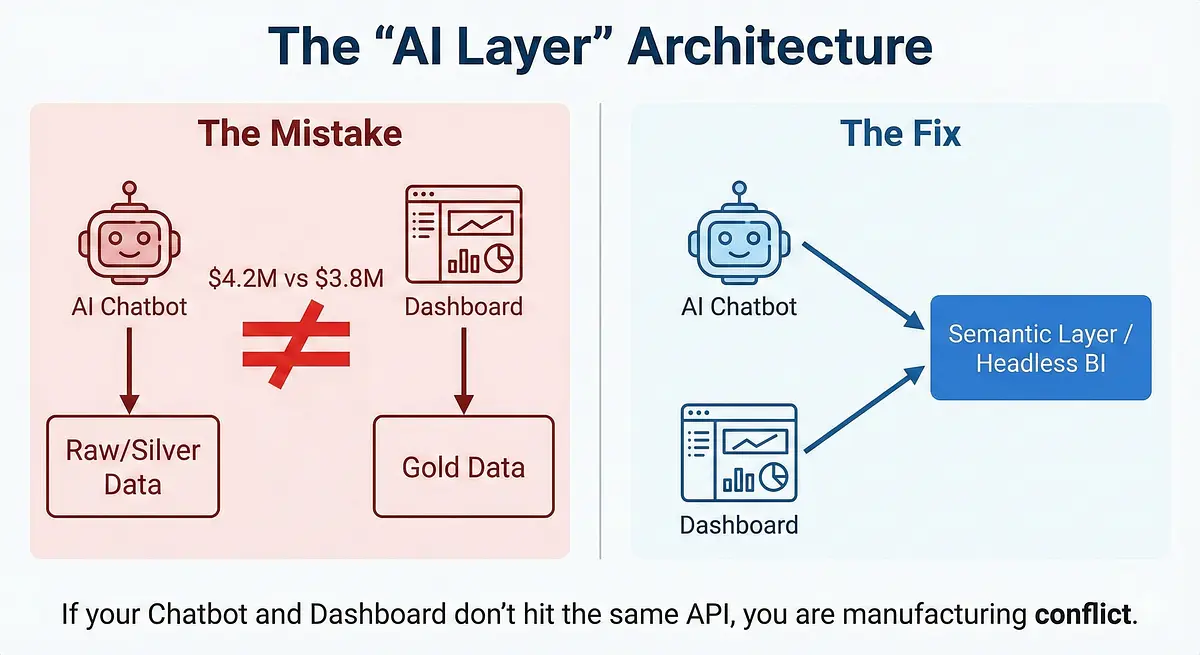
Here is the nightmare scenario I see in client meetings. The COO or CFO asks a chatbot a question about revenue. The chatbot gives one number. The VP of Sales looks at the Tableau dashboard, and it shows a completely different number.
Who gets blamed? You do.
The business loses trust in the data immediately. They will not blame the “magic AI box.” They will blame the data engineering team for the inconsistency.
The Fix
You need to architect a specific “AI Layer” within your warehouse specifically for AI to hit. In the industry, we call this a governed Semantic Layer. This is the single source of truth that the MCP server and APIs hit to retrieve answers.
This ensures the Chatbot hits the exact same logic as the Executive Dashboard. If you aren’t building this consistency into your architecture, you are building a system designed to create political conflict in the C-Suite. You need to understand governance, security, and data modeling to get data into a place where AI can give your executive team accurate responses.
4. Anti-Fragility: The “Quarantine Table” Defense
Juniors obsess over “Data Quality Scores.” Seniors obsess over “Who do I blame when this breaks?”
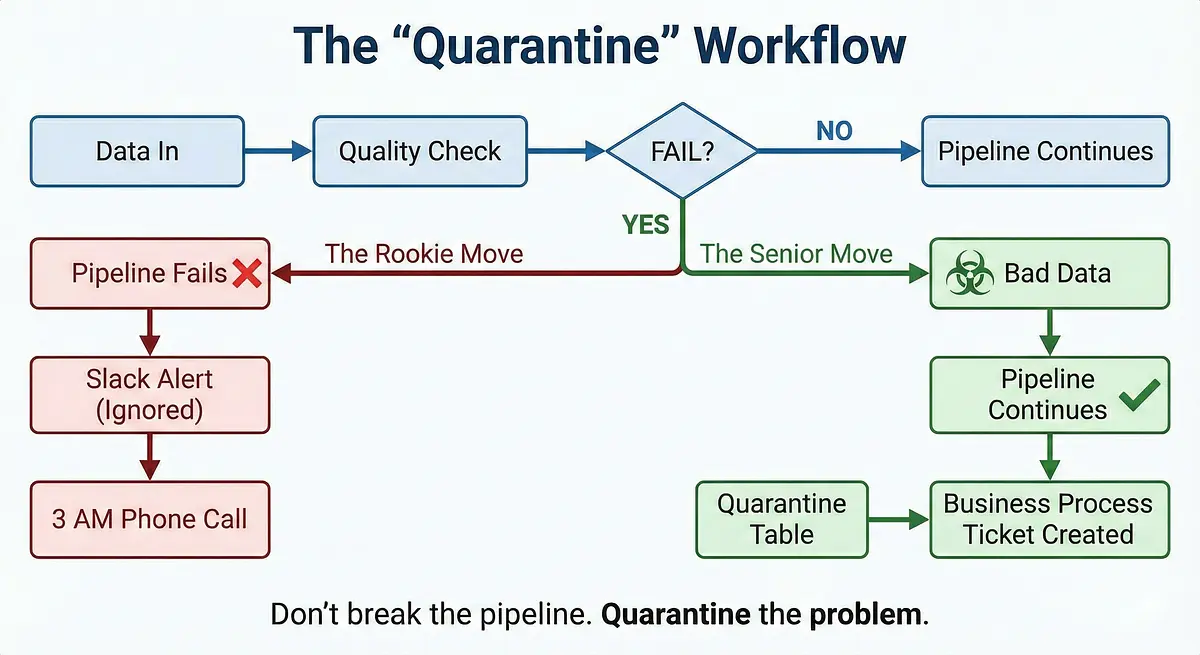
I see too many engineers relying solely on “Expectations” that just fail a pipeline silently or send a Slack alert that everyone ignores. If a human is entering data into your system, you need Quarantine Tables using tools like DQX.
The “War Room” Logic
When bad data hits production, I do not just want the pipeline to stop. I want that bad record isolated in a quarantine table. Why? Because having that quarantine table has saved my own tail in many situations over the years.
When the CFO asks why the report is wrong, I can open that table and say, “At this time and date, this person entered this character into the system.” It is easy to go back to the source and get them to fix it. This allows you to push the problem back to the source. It turns a “Data Engineering Problem” into a “Business Process Problem.”
That is how you survive in this industry. You build systems that protect your team from being the scapegoat. If the data issue is 100% system-generated, use expectations. But if a human touches it, use DQX and quarantine it.
5. Your Portfolio is Lying to Hiring Managers
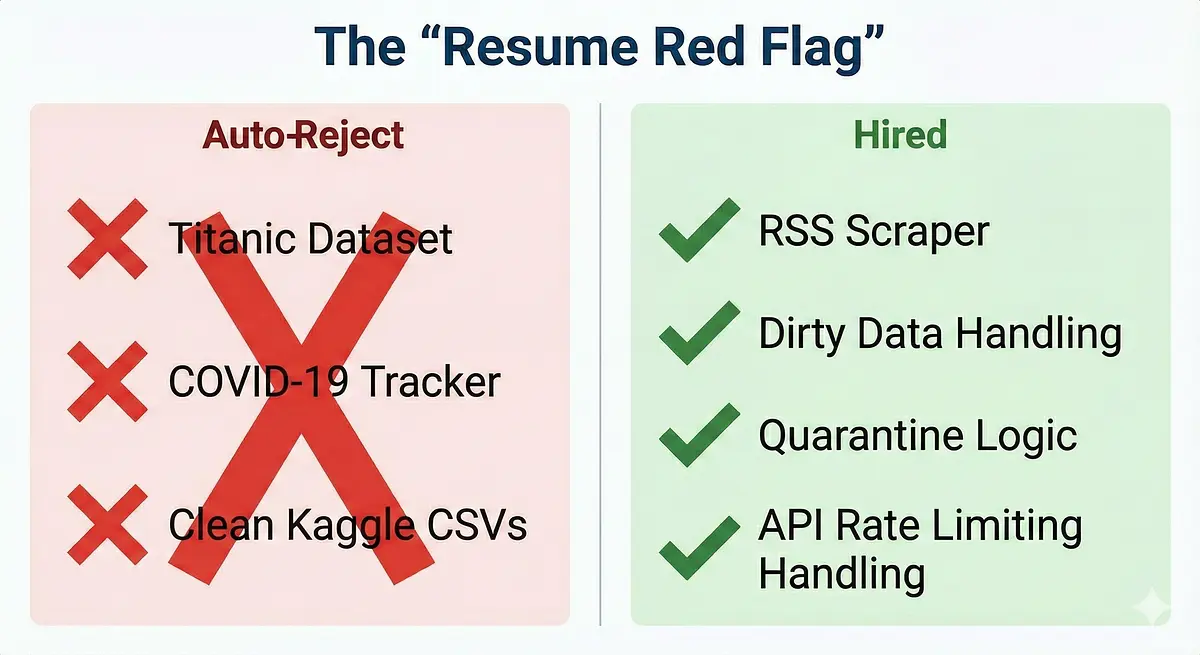
I review resumes constantly. If I see the Titanic dataset or the COVID-19 dataset on your GitHub, I am closing the tab. We are all tired of seeing them. They tell me you can follow a tutorial, not that you can solve a problem.
What I Hire For
I hire engineers who demonstrate curiosity and the ability to handle dirty data. Do not use a clean CSV from Kaggle. Instead, use government datasets that are often free and open. Or better yet, look at the project from one of our community members who is ingesting articles from RSS feeds, normalizing them, and clustering them into stories.
If you are trying to break into the industry or pivot from another IT role, you have to simulate “Company Experience.” Real company data is never clean. It is never on time. It is full of errors. You need to simulate those situations, simulate dirty data, and simulate hitting APIs.
Show me a project where you handled that and were able to troubleshoot those issues. Rearrange your resume to highlight those projects at the top. That is the experience hiring managers are looking for.
The Verdict
The job market in the US is still strong, and there are a ton of data engineering positions out there. But the bar has moved. The “Middle Skill” engineer who refuses to adapt to AI, who ignores orchestration, and who treats data engineering as “pipe cleaning” is walking into a dead end.
There is no shortfall of work to be done. But the work is now about Strategy, Architecture, and Reliability. You need to link every code decision to ROI and business value. Code to cash. Design for failure. And for the love of God, stop using the Titanic dataset.
About the Author
Chris Gambill
I am a Senior Data Strategy and Engineering Leader with over 25 years of experience building systems that handle billions of dollars and petabytes of data. I have survived outages, divestitures, budget cuts, and platform migrations.
I am here to share the brutal truth, Data Platform PTSD, and lessons that bootcamps won’t show you.
Gambill Data operates on three core pillars:
Code to Cash: If your code doesn’t solve a business problem or save money, it doesn’t have a reason for existence.
Anti-Fragility: The goal is not to avoid errors; it is to build systems, generate revenue, and excel in careers that survive them.
Strategy > Syntax: Anyone can write code. Few can architect for production.
If you are ready to stop thinking like a Junior Engineer and start thinking like a Strategic Partner, you are in the right place.
Join me in the trenches:
YouTube: The Data Engineering Channel – Weekly video breakdowns of production horrors and architectural reviews.
LinkedIn: (Chris Gambill & Gambill Data) Insights on navigating the data job market without the fluff.