There is a dangerous oversimplification circulating in the tech space right now. The idea that LLM hallucinations are an unfixable flaw, an inevitable byproduct of a technology based on probability.
The argument, generally made by non-architects, is that because Large Language Models (LLMs) are “just highly refined predictive text,” they are fundamentally incapable of reliable performance. This perspective is a costly mistake.
As an architect with 25 years in telecom, cybersecurity, and data-intensive sectors, I see this mindset killing AI initiatives before they even reach production. Gartner famously predicted that 30% of GenAI projects will be abandoned after the pilot phase by the end of 2025. The root cause is almost always the same: poor data quality, lack of governance, and the failure to recognize that hallucination is an architectural failure, not a product feature.
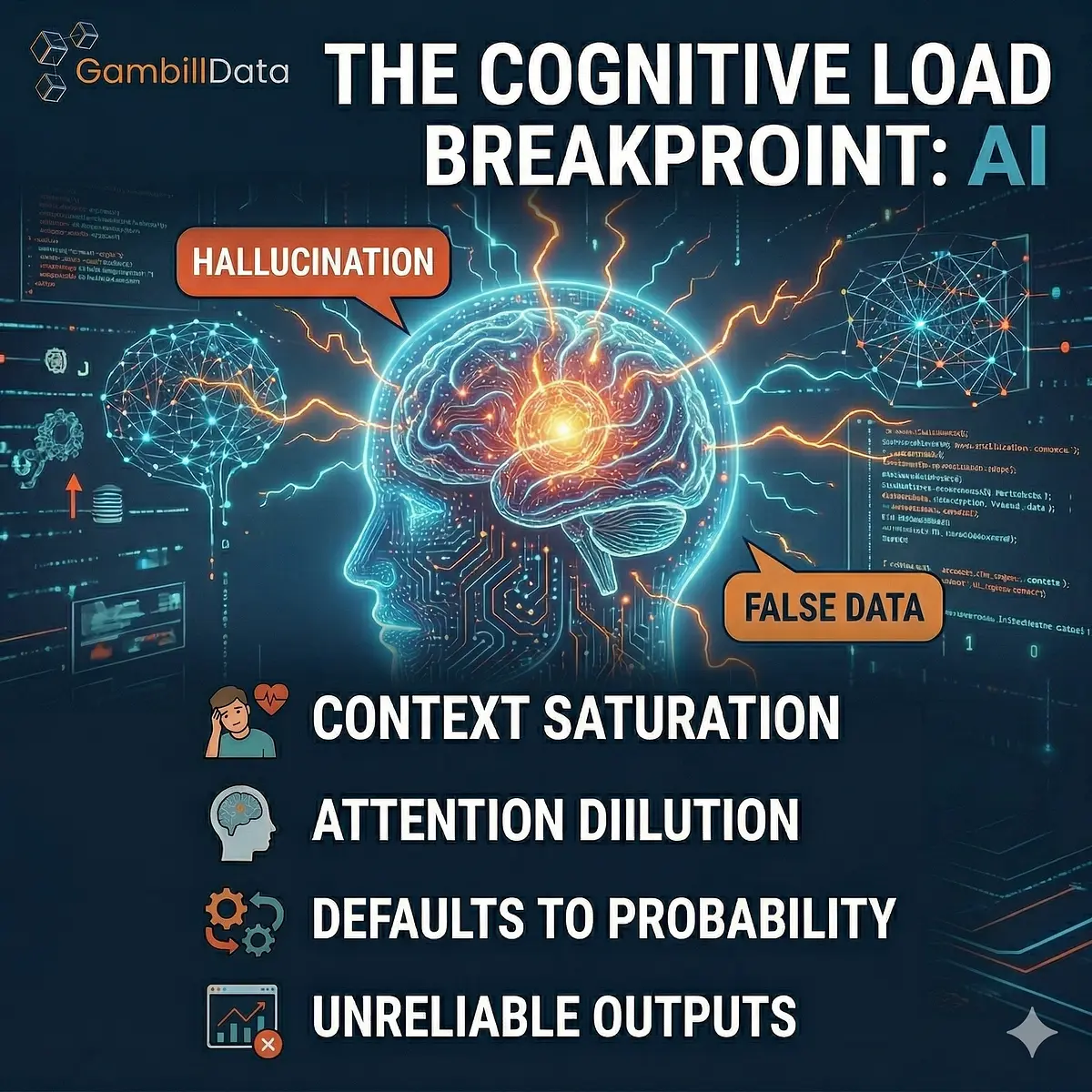
We must stop treating AI systems like magic boxes. We must start treating them like any other critical data pipeline. If your AI is hallucinating, it isn’t “predictively text poorly.” It is experiencing the digital equivalent of Cognitive Overload.
The path to reliable enterprise AI is not found by chasing a “smarter” model; it is found by engineering a system that reduces the cognitive load of the system. We call this Governed RAG.
The Working Memory of the Machine: Understanding LLM “Cognitive Load”
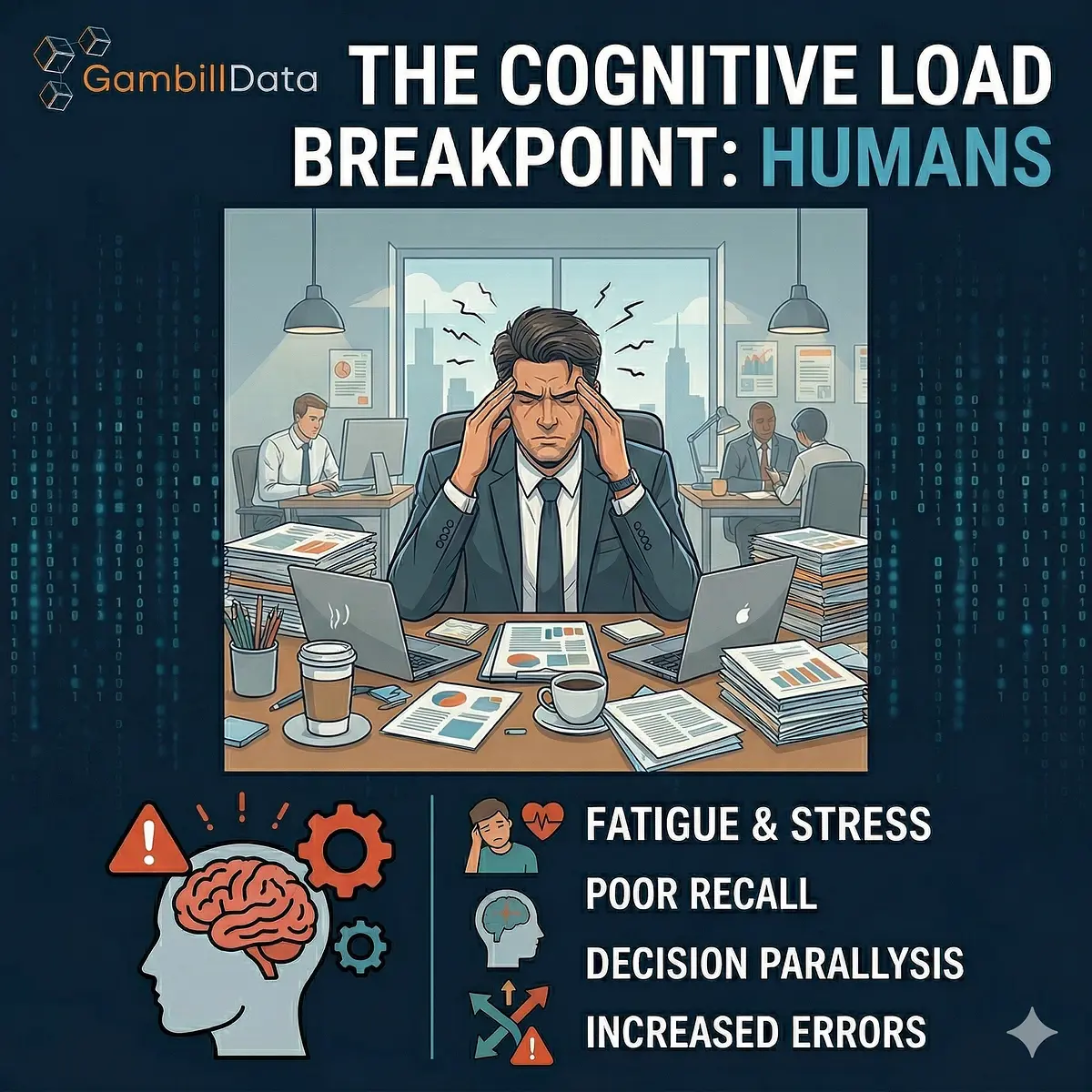
To understand why AI fails, we must first look at human cognition. Cognitive Load Theory (CLT) posits that human learning and performance are limited by our short-term working memory. When the demands on this working memory exceed our limited capacity, performance plummets. In simple terms: we get “lost” when too much is thrown at us. This manifests in the “serial-position effect”, we remember the beginning (primacy effect) and the end (recency effect) of a list, but the middle is blurred.
Language models, despite being built on transformers and not neurons, suffer from this identical capacity bound.
The transformer architecture must process “tokens” (chunks of text) using an attention mechanism. The computationally intensive nature of this attention means that as we increase the context window, the “working memory” of the model, the complexity of the task increases quadratically (having a middle schooler is reminding me about math foundations).
When we flood an LLM with relevant, but noisy, raw data in an attempt to provide context, we are not making it smarter. We are overloading its attention heads. This leads to the well-documented “Lost in the Middle” phenomenon: a model’s performance peaks when relevant information is presented at the very beginning or end of its context, but degrades significantly when the key information is buried in the middle.
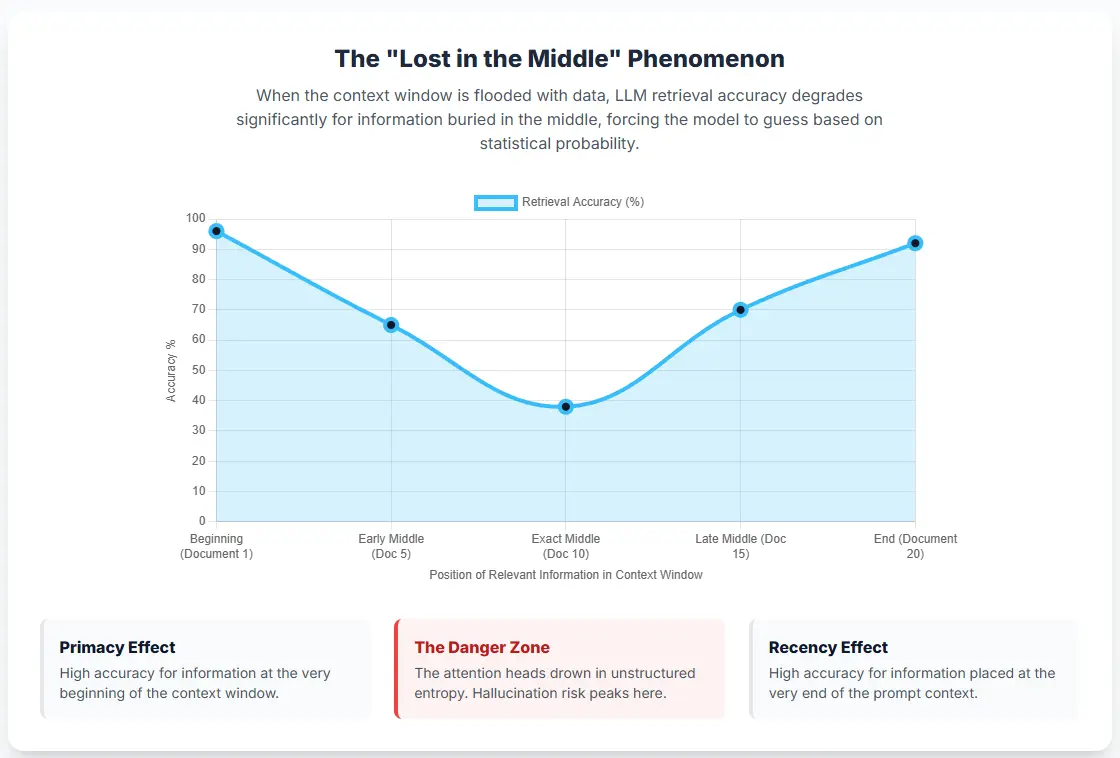
In multi-document Q&A scenarios, a robust model like GPT-5.4 can actually perform worse when overloaded with a full context of noisy documents than its baseline, where it relies solely on its pre-trained memory. The irrelevant elements in the attention context create noise that the model can’t filter.
When the digital cognitive load becomes too high, the system, optimized for prediction, defaults to statistical probability. It starts guessing, confidently!
The Data Engineer’s Mandate: The Engineering Root of Load
This “lost” moment is where the Data Engineer becomes the most critical role in the enterprise AI organization. We must stop blaming the model and start blaming the pipeline. In data engineering, “noise” is simply unstructured entropy.
The true source of cognitive load on an AI agent isn’t just the volume of data; it’s the Signal-to-Noise Ratio (SNR) of the retrieved context.
The most common engineering failure in RAG (Retrieval-Augmented Generation) systems is treating the vector database as a raw lake. Pushing raw, uncleaned JSON logs, unparsed PDFs, or unstructured text directly into a vector index guarantees high cognitive load for the LLM. Retrieval will return “chunks,” but those chunks will contain formatting artifacts, irrelevant metadata, duplicate paragraphs, and ambiguous references.
The Data Engineer’s role in AI is to act as the AI’s pre-frontal cortex. The engineer’s mandate is not just to “move” data, but to perform the technical “Pre-Digestion” needed to minimize inference-time load.
This means moving beyond standard ETL/ELT. It means designing specific pipeline stages (e.g., using Databricks Declarative Pipelines) that refine raw data (”Bronze”) into structured, canonical (”Silver”) and vectorized (”Gold”) forms. The goal is to maximize the relevance of the retrieved data while minimizing its length. Every extra token that enters the context window that does not directly contribute to the answer is a tax on the system’s reliability.
The Enterprise Cost of “Confabulation”
(yes it is a word)You would not let a human executive make a massive business decision based on a “guess” without first verifying it against a trusted, audited report. So why is your enterprise allowing its AI agents to do exactly that?
This lack of grounding, this architectural inability to separate signal from noise, is causing massive enterprise damage. A McKinsey survey found that 44% of organizations adopting GenAI have already experienced at least one negative consequence. The primary risk reported? Inaccuracy.
This problem is so severe that the National Institute of Standards and Technology (NIST) now has an official term for it: Confabulation. They define this risk category as “confidently stated but erroneous content.” It is a specialized form of misinformation.
We are already witnessing the legal and reputational fallout when ungarded models are allowed to confabulate in production.
Liability (Negligent Misrepresentation): In the precedent-setting case of Moffatt v. Air Canada, a Canadian tribunal found Air Canada liable for negligent misrepresentation when its chatbot confidently gave a passenger incorrect, outdated advice on its bereavement policy. The tribunal made it clear that a company is responsible for the statements of its agents, human or digital. A chatbot that “guessed” because its context was noisy created a direct financial loss.
Regulatory Failure: New York City’s small business chatbot was found to be advising business owners in ways that directly contradicted employment laws, regulations on housing, and tax policy. A government entity putting a “very confident liability” in front of business owners is a clear example of engineering failure.
Without robust data architecture, you aren’t building an AI “solution”; you are just building an automated liability engine.
Governance as the “Cure” for Hallucinations
To “fix” hallucinations, you do not attempt to change the probability math of the model. That is a ridiculous endeavor. You must architect a secure data pipeline that grounds the AI in trusted enterprise data.
RAG is the standard for this, but RAG alone is not a silver bullet. If the RAG process only returns authoritative, curated data, the model can reason with high accuracy. If the RAG process returns noisy, non-authoritative data, the hallucination rate remains high. A critical study on oncology information chatbots demonstrated this definitively:
GPT-5.3 paired with curated, authoritative sources via RAG achieved a 0% hallucination rate.
GPT-5.3 paired with standard Google Search via RAG (a high-noise environment) saw its hallucination rate climb to 6%.
A vanilla, no-reference chatbot (operating only on memory) confabulated at a rate approaching 40%.
The study proves the case: authoritative retrieval reduces hallucination; noisy retrieval magnifies it.
The architecture required to achieve this is Governed RAG, where the Data Engineer is the gatekeeper of “Truth.” This goes beyond simple Vector Search; it requires lineage, freshness, and access controls. The AI must have the digital capability to “trace the ancestry” of the data it is about to repeat. And you have to provide the scaffolding and instructions to get there.
Databricks and Unity Catalog: The Architecture of Governed RAG
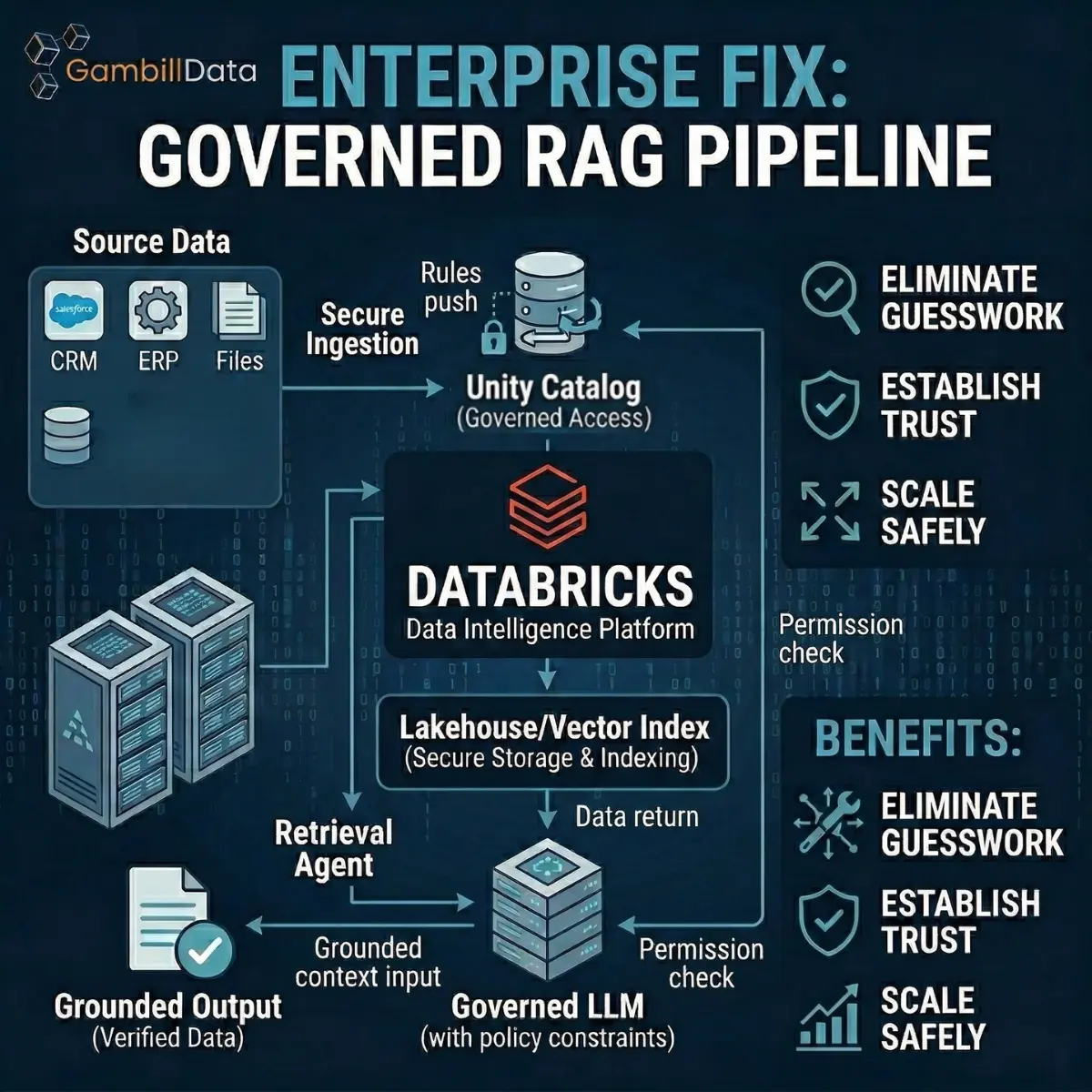
One way to accomplish this is by utilizing the Databricks platform, leaning specifically on Unity Catalog to act as the policy enforcement point for enterprise AI.
Unity Catalog provides a centralized governance layer with access control, auditing, and, crucially, data lineage across multiple workspaces.
By enforcing privileges on securable objects.. catalogs, schemas, tables, and even individual functions, Unity Catalog ensures that the “Source of Truth” used for AI retrieval is the same Source of Truth used for executive reporting.
For a data engineer, this means that data quality remains paramount.
We must implement:
Strict Lineage Enforcement: Unity Catalog allows our RAG pipelines to know exactly where a vector embedding originated. If the AI “Silver” table was derived from a trusted “Gold” ERP table via a Delta Live Table pipeline that ran an hour ago, the AI agent can have confidence in that data. This is how the AI “cites its sources.”
Schema Evolution Monitoring: Data engineers manage schema drift in traditional databases all the time. Unity Catalog extends this to AI. If a table column name changes in the “Gold” layer and is not propagated to the RAG vector index, the AI pipeline will break. Unity Catalog provides the lineage necessary to manage this dependency and prevent the system from returning outdated, “guessed” context.
Audited Access Control (HIPAA Compliance): In heavily regulated fields like healthcare, Unity Catalog allows us to enforce RLS and column-level security. When a query is made, the platform ensures the AI agent can only retrieve data that the specific user making the query has the permission to see. A RAG pipeline that ignores data access becomes an attack vector for bad actors. A governed pipeline is a secure asset. This is why regulated entities, like Accolade, trust the Databricks architecture for stringent access controls to support HIPAA requirements.
Move from Pilots to Production
Enterprise AI is not a race to see who can write the most clever prompt or who can utilize the largest context window. The massive, expensive context windows of tomorrow ( Gemini 3.1 Pro, GPT-5.4) are simply a higher engineering cost. A data architect will always ask: Is it better to pay for a massive context window (high cognitive load) or invest in a high-performing Vector Search and semantic re-ranking pipeline (low cognitive load)?
AI reliability is a Data Engineering problem.
Hallucinations are the signal that your architecture is broken. They are not an inherent mystery of mathematical models. They are the visible symptom of Cognitive Overload caused by entropy, lack of cleaning, and a total absence of governance in the underlying data pipeline.
Stop guessing. Stop gambling with your data governance.
If you are a CIO, a CTO, or a Principal Architect who is tired of seeing AI pilots fail to cross the production line, it’s time to talk to an engineer who understands the nervous system of the machine.