You watched the streams (or maybe there live). You saw the demos from Microsoft Build, Snowflake, and Databricks Data + AI Summit.
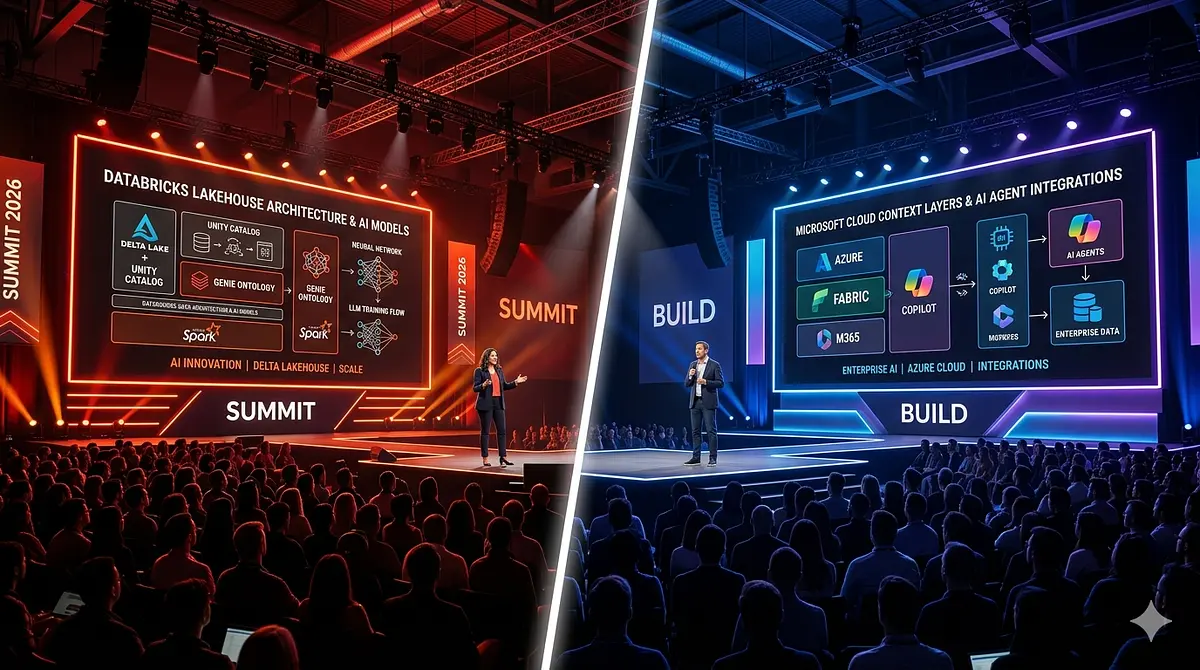
Now you are sitting in a Monday leadership meeting, debating whether Fabric or Databricks is the ultimate “context layer” for your organization. You are pulling up vendor architecture slides and arguing about which AI agent is going to seamlessly integrate with your existing workflows.
You are falling into The Keynote Trap. You think a new compute engine will fix a broken business consensus.
It is a lie. You aren’t modernizing your architecture. You are just preparing to migrate your mess.
The Hard Truth About the “Platform War”
We are watching a massive pivot in the industry. The hyper-scalers have realized that compute and storage are largely commoditized. The new battleground is the semantic layer. Microsoft is pitching Fabric as the context layer for AI. Databricks just announced the Genie Ontology to map natural language to specific data assets.
These are brilliant pieces of software. But they are treating a symptom, not the disease.
The actual problem in enterprise data has rarely been mapping the right question to the right table. The problem is that the business has not decided what the right question is.
Let us get one thing straight about AI agents and the current panic over data quality. If you point a highly capable LLM at your Silver layer where three different departments have three different definitions for “Active Customer”, the system is going to give you an answer. And when it confidently hands your executive team a dashboard that contradicts the CRM, everyone will scream that the AI is “hallucinating.”

It isn’t hallucinating.
The AI is giving you exactly what you asked for. It just exposed the fact that you gave the machine three different calculations for a single business question. The machine is doing its job perfectly. The business failed to do its job.
The Governance Delusion
If your CFO and CMO cannot agree on the strict mathematical definition of Monthly Recurring Revenue (and they rarely do), an AI agent is not going to magically broker a peace treaty for them.
These tools assume the existence of a clean, governed, and agreed-upon reality. When that reality does not exist, the platform just helps you generate the wrong answer faster.
A new platform is just a new sorting floor. Moving from Snowflake to Fabric without standardized business metrics is just paying consultants millions of dollars to relocate your garbage.
You cannot buy context. You have to engineer it.

The vendor will not take the blame for your dirty data. The executives will not blame themselves for their lack of alignment. The blame will fall entirely on the data engineering team for building a “broken” system. Who gets blamed? You do.
The Platinum Mandate
This brings us to the core architectural failure of the agentic era. You are letting your AI read from the wrong floor of the warehouse.
As outlined in the Medallion operating model, Silver is the governance boundary where data is standardized. It is not business-ready. Gold is the storefront built for humans to read. Platinum is the strict machine contract built for systems to consume.
Your AI agents should never have access to the Silver layer. Giving an LLM raw query access to un-aggregated standardization tables is an invitation for disaster. Governance in the age of AI means ensuring the machine only has access to the Gold or Platinum layer, where the context is pre-computed and mathematically locked.
This is exactly why tools like the Databricks Unity AI Gateway exist. Governance is no longer just about who can read a table. It is about actively restricting what an agent is allowed to touch, invoke, or reason over at runtime. If you cannot draw a hard perimeter around your trusted context, you do not have an architecture. You have a liability.
The Reality Protocol
You cannot survive this transition by reading documentation or watching vendor sizzle reels. You have to force the business to do the hard work of defining reality.
Before you sign a multi-year enterprise agreement based on a platform war, you must run this sanity check.
1. Map the Data Gravity
Where does the data physically live right now? What does the migration actually cost in operational downtime and dual-running compute bills? You need to know the exact weight of your current architecture before you try to move it.
2. Force the Definition
Who owns the mathematical definition of your primary KPIs? If it isn’t documented, version-controlled, and agreed upon by the C-Suite, the platform does not matter. Force the executives to sign off on the math before you write a single line of SQL. Treat business logic as a strict engineering boundary.
3. Quarantine the Agents
Audit your security model. Ensure that AI agents are physically walled off from Bronze and Silver schemas. Route their access exclusively through the Unity AI Gateway to hit your Platinum layer. If you do not lock the doors, the agents will wander.
4. Audit the Skillset
Does your internal team know how to operate this specific stack? Are you relying on a 10-Year Junior who has mastered a GUI but cannot write production-grade code? Mastering a specific vendor’s interface is not engineering. It is a tooling crutch. If you do not have the internal capability, you are buying a multi-year dependency on an outside consulting firm.
Every step of this protocol requires someone who has done this before. It requires someone who can look past the marketing hype and evaluate the actual blast radius of the decision.
The Verdict
Architecture is about boardroom survival. You must choose your tools based on your actual constraints, your team’s depth, and your business readiness. You do not choose based on someone else’s keynote announcement.
If your leadership team is arguing over vendors instead of business outcomes, you need a reset.
These audits and architectural reviews are what we do at Gambill Data. We don’t do “Happy Paths” or vendor cheerleading. We do Production-Grade reality. Do not let the excitement of last month’s keynotes expedite a multi-year financial mistake.
Stop guessing. Book a strategy call today.
What’s new in Unity AI Gateway
This breakdown from Databricks highlights how the Unity AI Gateway functions as the centralized governance layer you need to effectively quarantine your agents and control your AI spend.