In the modern data estate, the most dangerous operational state is not the catastrophic failure. It is the silent success.
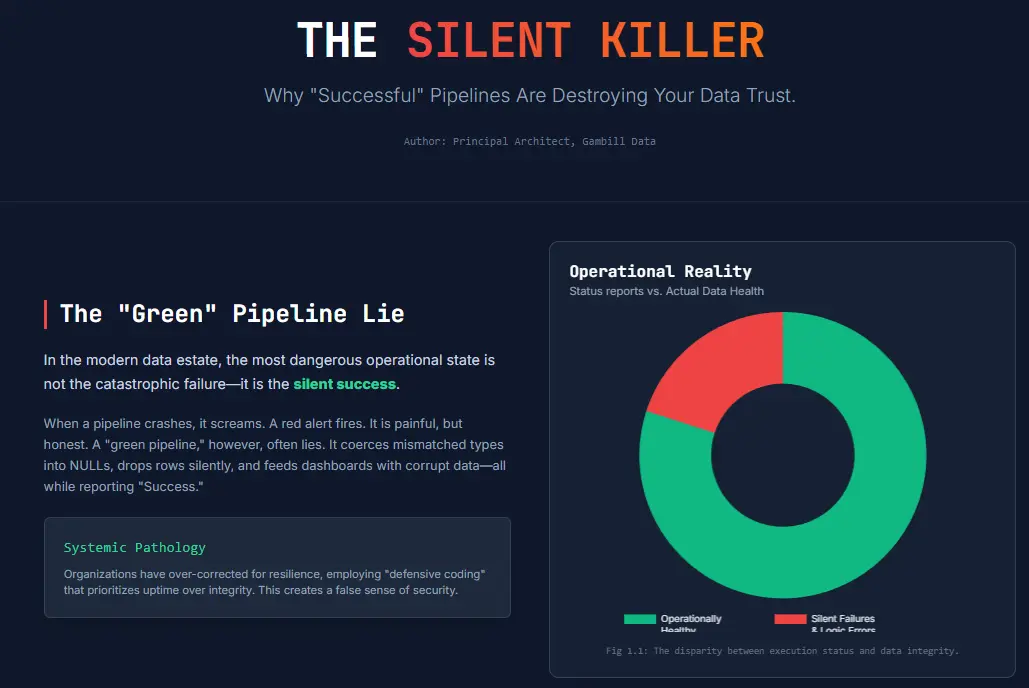
When a pipeline crashes, it screams. A red alert fires in Azure Data Factory, a rigid stack trace explodes in a Databricks executor, and the on-call engineer is summoned. It is painful, but it is honest. A red pipeline admits it has failed.
The “green pipeline,” however, lies. It is the ingestion job that coerces mismatched schema types into NULLs without logging a warning. It is the transformation logic that silently drops 10% of your revenue rows because of a drift in the source system. It completes its execution with a “Success” status, refreshing executive dashboards and feeding ML models with data that is fundamentally corrupt.
At Gambill Data, we see this systemic pathology constantly. Organizations have over-corrected for resilience, prioritizing uptime over integrity. They employ “defensive coding” patterns, specifically the abuse of broad try-catch blocks and “fail-safe” defaults, that mask critical errors.
This isn’t just a technical annoyance. It is a financial liability. Here is why you need to stop coding defensively and start auditing offensively.
The Psychology of the “Catch-All” Block
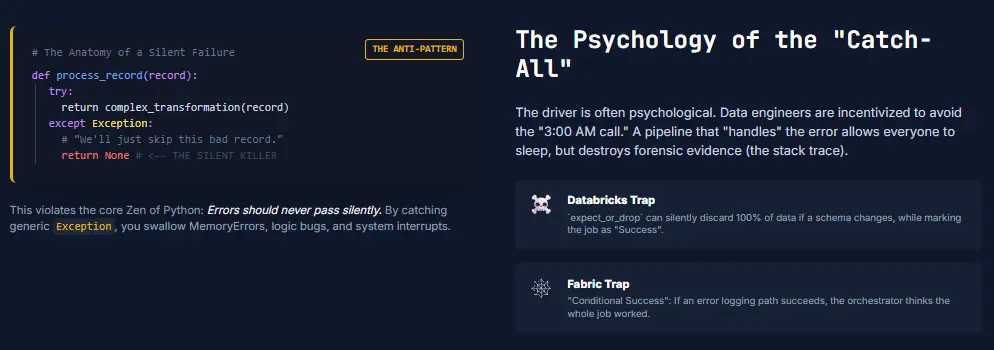
The driver of silent failure is often psychological, not technical. Data engineers are incentivized to avoid the “3:00 AM call.” A pipeline that crashes requires immediate human intervention. A pipeline that “handles” the error and finishes allows everyone to sleep.
This leads to the “Catch-All” Anti-Pattern in Python and PySpark:
# The Anatomy of a Silent Failure
def process_record(record):
    try:
        return complex_transformation(record)
    except Exception:
        # "Skip this bad record and keep rolling."
        return None
This violates the core Zen of Python: Errors should never pass silently. By catching Exception, you aren’t just catching bad data; you are swallowing MemoryErrors, logic bugs (ZeroDivisionError), and even system interrupts.
The result? The stack trace, your forensic evidence, is destroyed. The pipeline reports success. But downstream, the data has holes in it. You have traded short-term operational peace for long-term strategic rot.
The Financial Blast Radius
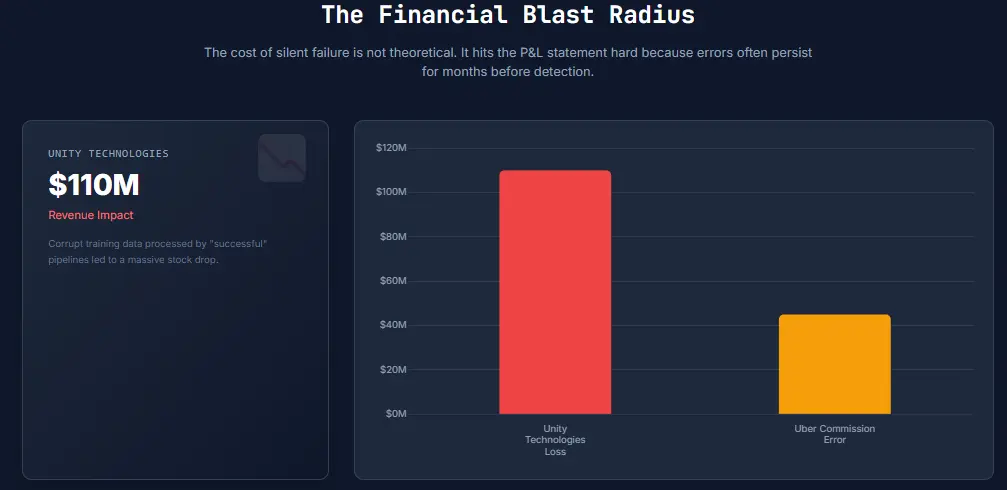
The cost of silent failure is not theoretical. It hits the P&L statement hard because the error often persists for months before detection.
Unity Technologies ($110 Million Loss): Unity’s ad-targeting algorithms were fed corrupt training data. The pipelines didn’t crash; they just processed garbage. The result was a $110 million impact on revenue and a 37% stock drop.
Uber ($45 Million Error): A logic flaw in Uber’s driver commission calculations went undetected for two years. The pipelines ran successfully every day, paying out incorrect amounts totaling $45 million.
In both cases, the systems were “green.” They were operationally successful but semantically bankrupt.
The Trap in Your Platform
Whether you are on Databricks or Fabric, the default tools often favor flexibility over strictness. You must actively configure them to prevent silent failures.
1. Databricks: The expect_or_drop Illusion
In Lakeflow Declarative PIpelines (AKA. DLT), you can define expectations to manage data quality. A common choice is expect_or_drop, which discards records that violate rules so the pipeline can continue.
The Risk: If an upstream schema change causes every row to violate the rule, DLT will silently drop 100% of your data and mark the pipeline as “Succeeded.” Your dashboard will show zero revenue for the day, and you won’t know why until the CEO calls.
The Gambill Stance: Unless you have an alert specifically monitoring the
dropped_recordsmetric, useexpect_or_fail. Halt the pipeline. Force the fix.
2. Fabric: The “Conditional Success”
In a Fabric Data Factory, when you create an “On Failure” path (e.g., to log an error), the pipeline considers the failure “handled.” If the logging activity succeeds, the overall pipeline status is reported as “Succeeded,” even though the data movement failed.
The Gambill Stance: You must explicitly add a Fail Activity at the end of your error handling branch. The orchestrator must know that the job failed, or no one will look at the logs.
The Solution: Offensive Data Engineering
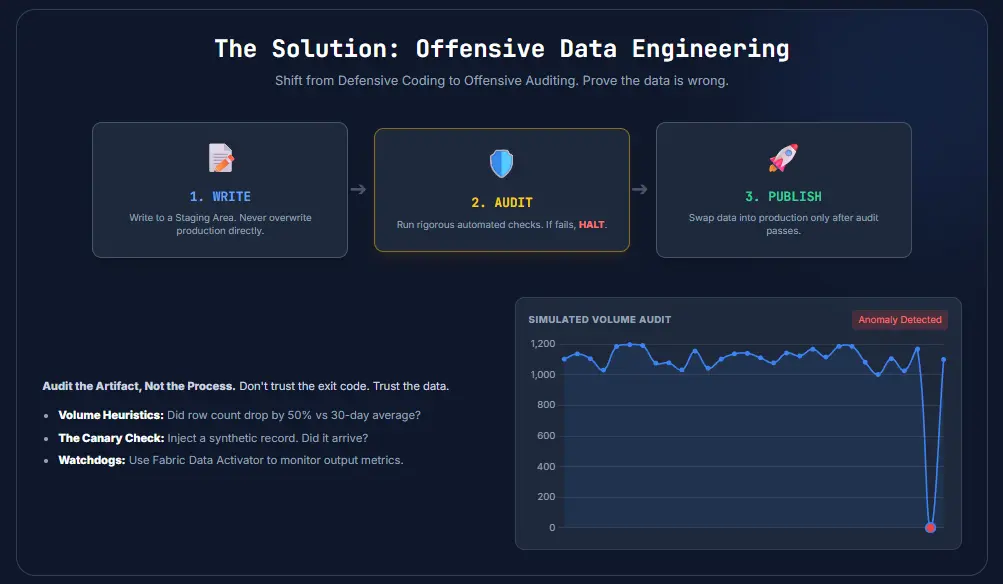
We need to shift from Defensive Coding (trying to keep the pipeline alive at all costs) to Offensive Auditing (trying to prove the data is wrong).
1. The Write-Audit-Publish (WAP) Pattern
Never overwrite production data directly. Write to a staging area (”Write”), run rigorous automated checks (”Audit”), and only if those pass, swap the data into production (”Publish”). If the audit fails, the pipeline halts. The consumers see old data (which is safe), not corrupt data (which is dangerous).
2. Audit the Artifact, Not the Process
Don’t trust the exit code. Trust the data.
Volume Heuristics: Did the row count drop by 50% compared to the 30-day moving average?
The Canary Check: Inject a synthetic “canary” record at the source. If it doesn’t appear in the Gold layer, the pipeline is silently dropping data.
3. Fabric Data Activator as a Watchdog
Use Fabric’s Data Activator to monitor the output metrics (e.g., total sales in a Power BI dataset). Set a reflex that triggers if Total_Sales drops to zero or deviates significantly. This catches the logic errors that the pipeline logs miss.
Conclusion: Trust is the Asset
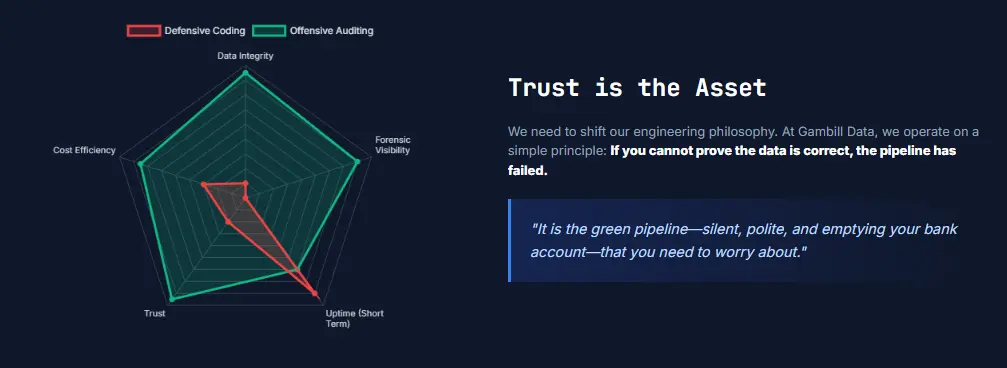
At Gambill Data, we operate on a simple principle: If you cannot prove the data is correct, the pipeline has failed.
It is time to stop fearing the red pipeline. The red pipeline is asking for help. It is the green pipeline, silent, polite, and emptying your bank account, that you need to worry about.
About the Author
Chris Gambill
I am a Senior Data Strategy and Engineering Leader with over 25 years of experience building systems that handle billions of dollars and petabytes of data. I have survived outages, divestitures, budget cuts, and platform migrations.
I am here to share the brutal truth, Data Platform PTSD, and lessons that bootcamps won’t show you.
Gambill Data operates on three core pillars:
Code to Cash: If your code doesn’t solve a business problem or save money, it doesn’t have a reason for existence.
Anti-Fragility: The goal is not to avoid errors; it is to build systems, generate revenue, and excel in careers that survive them.
Strategy > Syntax: Anyone can write code. Few can architect for production.
If you are ready to stop thinking like a Junior Engineer and start thinking like a Strategic Partner, you are in the right place.
Join me in the trenches:
YouTube: The Data Engineering Channel – Weekly video breakdowns of production horrors and architectural reviews.
LinkedIn: (Chris Gambill & Gambill Data) Insights on navigating the data job market without the fluff.
Reference link to Uber and Unity errors: https://greatexpectations.io/blog/when-bad-data-ruins-business-real-world-consequences/