I spoke with a coaching student that was working in a $2M/year environment. The student thought their code was the problem. They thought they needed better partitioning or more aggressive Z-Ordering.
They were wrong.

When we opened the system tables, we didn’t find bad code. We found architectural failure. Nearly 30% of their annual spend was pure “Zombie Compute” clusters spinning in the void, burning Databricks Units (DBUs) and EC2 hours while doing absolutely zero mathematical work.
In this industry, there is a dangerous misconception that if the pipeline finishes and the Grafana board is green, the engineer did their job. But if you are a Data Engineering Director relying on Databricks’ out-of-the-box defaults to manage your infrastructure, you are making a voluntary, untracked donation to your cloud provider.
If I am the Hiring Manager, and I catch a Senior Engineer treating the cloud like an open bar because they didn’t want to write a JSON cluster policy, that is a firing offense.
Here is the exact evidence we pulled from the War Room. If your environment looks like this, you are bleeding cash.
Exhibit A: The Driver Node Bloodbath
Apache Spark relies on a primary-secondary architecture. The workers (executors) do the heavy lifting. The driver just acts as a traffic cop, scheduling the Directed Acyclic Graph (DAG) and monitoring telemetry.
But when a junior engineer clicks “Create Cluster” in the UI without a governance policy, the platform executes a fatal assumption: “Auto / Same as worker.”
If your developer selects a massive AWS m5.xlarge for their workers to handle heavy transformations, the UI automatically provisions an m5.xlarge for the driver. You are paying for a memory-optimized, 4-vCPU machine to sit there and play traffic cop.
The Code to Cash Reality:
The Default Configuration:
m5.xlargedriver consuming 0.75 DBUs/hr.The Right-Sized Reality:
m5.largedriver consuming 0.40 DBUs/hr.The Delta: ~$0.28 per hour, per cluster.
The Blast Radius (50 clusters running 24/7): $346.20 burned daily.
Annual Cash Incinerated: $124,632.00.
The Verdict: You are paying $124k a year for an over-provisioned JVM that provides zero computational benefit.
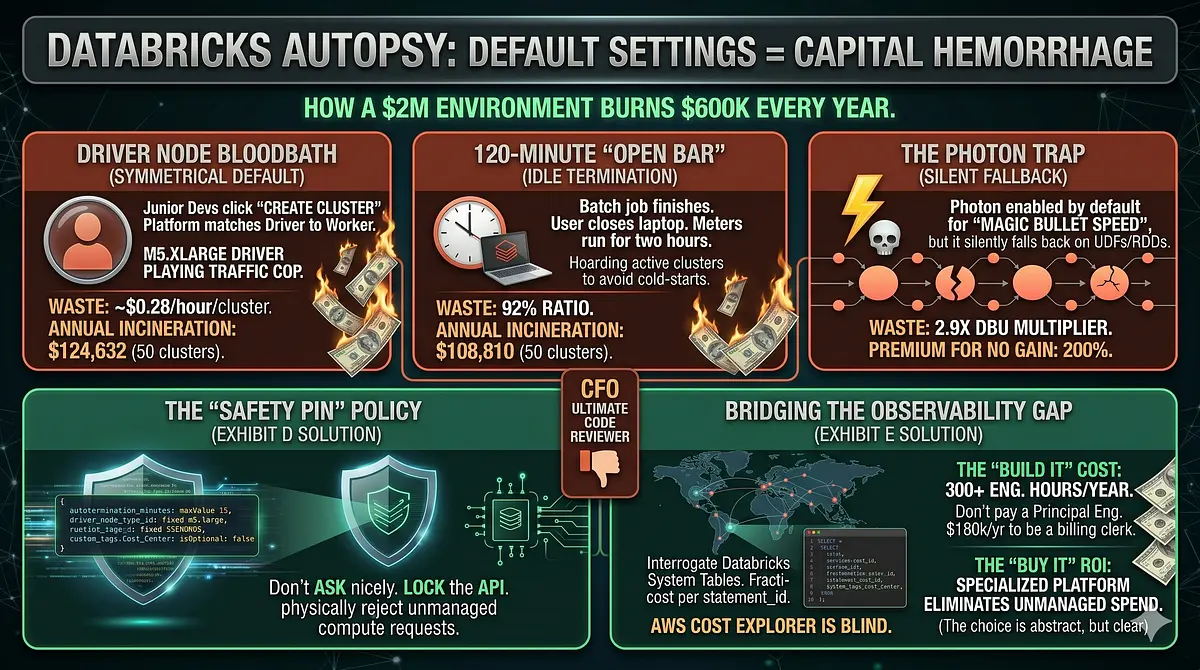
Exhibit B: The 120-Minute “Open Bar”
Engineers hate the cold-start penalty. Waiting 5 to 7 minutes for virtual machines to boot ruins flow state. To compensate, developers hoard active clusters.
Databricks attempts to manage this with an auto_termination_minutes setting. But the legacy default populated in the UI is a staggeringly permissive 120 minutes.
An analyst runs a 10-minute SQL aggregation and then goes to lunch. The cluster doesn’t know the human is gone. It remains fully active, holding the VMs hostage, polling Ganglia metrics, and burning DBUs for two subsequent hours before the termination wall hits.
The Code to Cash Reality:
Active Processing Time: 10 minutes.
Idle “Zombie” Time: 2.0 hours.
Daily Idle Cost (50 clusters): $302.25.
Annual Cash Incinerated: $108,810.00.
The Verdict: Your pipelines have a 92% waste ratio. You are paying thousands of dollars a week to run clusters while your engineers are eating sandwiches.
Exhibit C: The Photon Trap
Photon is enabled by default on newer runtimes and pitched as a magic bullet for query speed. The catch? It applies a massive 2.9x DBU multiplier on Jobs Compute.
The trap is the “Silent Fallback.” Photon does not support the entire Spark API. It cannot accelerate custom Python UDFs, legacy RDDs, or pipelines completely bottlenecked by network I/O. If your Catalyst Optimizer encounters an unsupported operation, execution seamlessly reverts to the standard JVM-based Spark engine.
The pipeline succeeds. No alarms go off. But you are still paying that 2.9x DBU premium for a high-performance engine that the physical plan completely ignored.
Worse, because Photon allocates massive memory off-heap, that fallback starves the standard JVM. Your junior dev panics at 2:00 AM, doubles the instance size to fix the SparkOutOfMemoryError, and unknowingly accelerates the cash bleed. They are fighting a hardware ghost created by a bad default.
The Code to Cash Reality:
Standard Jobs Compute: ~0.15 DBUs/hr.
Photon-Enabled Jobs Compute: ~0.44 DBUs/hr (2.9x multiplier).
The Silent Fallback: Your engine reverts to standard Spark, but you still pay the 0.44 rate.
The Verdict: You are paying a 200% premium for a C++ engine that the physical query plan is completely ignoring.
Exhibit D: The “Safety Pin” (Production-Grade Governance)
You don’t fix this with a Slack message reminding juniors to turn off their clusters. You fix this by locking the Databricks API so they physically cannot make the mistake.
Copy and paste this exact policy into your control plane today, or keep writing checks to your cloud provider.
{
"autotermination_minutes": {
"type": "range",
"maxValue": 15,
"defaultValue": 15,
"isOptional": false
},
"driver_node_type_id": {
"type": "fixed",
"value": "m5.large",
"hidden": false
},
"runtime_engine": {
"type": "fixed",
"value": "STANDARD",
"hidden": true
},
"custom_tags.Cost_Center": {
"type": "unlimited",
"isOptional": false
}
}
This is a structural tourniquet. It hard-caps auto-termination at 15 minutes. It forces a right-sized driver. It hides the Photon toggle. And most importantly, it makes the Cost_Center tag mandatory. No tag, no compute.
Exhibit E: The Observability Gap
When the AWS or Azure bill spikes by $30,000, your native cloud dashboards are useless. AWS Cost Explorer suffers from a “Billing Identity Smear.” It can tell you that you spent money on EC2 and Databricks API calls, but it cannot map that spend to a specific query, pipeline, or developer.
To bridge this gap, you have to interrogate the internal Databricks System Tables. Specifically, you have to write and maintain complex Slowly Changing Dimension (SCD) Type 2 joins between system.billing.usage (where the DBUs live) and system.query.history (where the execution times and user IDs live).
You have to fractionalize the cost down to the exact statement_id. If you want to know who is burning your budget, this is the nightmare SQL required to find out:
WITH warehouse_costs AS (
SELECT
u.usage_metadata.warehouse_id,
date_trunc('hour', u.usage_start_time) AS hour_bucket,
SUM(u.usage_quantity * p.pricing.default) AS hourly_cost_usd
FROM system.billing.usage u
LEFT JOIN system.billing.list_prices p
ON u.sku_name = p.sku_name
AND u.usage_unit = p.usage_unit
AND u.usage_end_time >= p.price_start_time
AND u.usage_end_time < COALESCE(p.price_end_time, '2099-12-31')
WHERE u.usage_metadata.warehouse_id IS NOT NULL
GROUP BY 1, 2
),
query_durations AS (
SELECT
h.compute.warehouse_id,
date_trunc('hour', h.start_time) AS hour_bucket,
h.executed_by,
h.statement_id,
h.total_task_duration_ms,
SUM(h.total_task_duration_ms) OVER (
PARTITION BY h.compute.warehouse_id, date_trunc('hour', h.start_time)
) AS total_warehouse_ms
FROM system.query.history h
WHERE h.compute.type = 'WAREHOUSE'
AND h.execution_status IN ('FINISHED','FAILED','CANCELED')
)
SELECT
q.executed_by AS runaway_user,
q.statement_id,
(q.total_task_duration_ms / q.total_warehouse_ms) * w.hourly_cost_usd AS query_attributed_cost_usd
FROM query_durations q
INNER JOIN warehouse_costs w
ON q.warehouse_id = w.warehouse_id
AND q.hour_bucket = w.hour_bucket
ORDER BY query_attributed_cost_usd DESC;
I watch teams spend hundreds of engineering hours a year trying to build custom FinOps pipelines to parse these system tables. Parsing billing logs does not generate revenue. You either invest in a specialized observability platform, or you pay a Principal Engineer $180,000 a year to act as a glorified billing clerk.
We are no longer living in a zero-interest-rate environment where “move fast and break things” applies to the infrastructure budget. In this economy, the CFO is the ultimate code reviewer. If you cannot look your VP of Engineering in the eye and prove that your data platform’s unit economics are profitable, you aren’t an engineer… you’re an operational liability.
Code to Cash. Lock down your defaults.
Stop Doing Tutorials. Start Building Evidence.
If you walk into an interview with a sanitized, copy-pasted tutorial dataset, the interview is over. You don’t need another certificate. You need an undeniable portfolio of production-grade architecture.
The Gambill Coaching Project Creator forces you to build “Code to Cash” systems that survive the War Room.
The Blueprint Engine ($49/mo): Paste the URLs of your target roles. Our AI engine cross-references your resume and generates a custom, enterprise-grade Statement of Work. Every technical task is mapped directly to a business outcome, exportable as an “Evidence Brief” to slide across the table at your next interview.
The Async War Room ($99/mo): Everything in the Blueprint Engine, plus gated access to the Director. Submit your milestones and get up to two asynchronous code reviews per month. I will tear down your architecture and expose your financial blindspots before a hiring manager does.
Don’t tell them you know data engineering. Prove it.