We have all been there. It is 2:00 AM on a Friday. You are on your 16th hour of a "sprint" that feels more like a marathon through a minefield. The business needs the Finance dashboard now. They ask you to skip the validation. They want you to push straight to Production.
In that moment, you feel it like being punched in the gut… “Should I be able to do this faster? Am I failing because I’m not good enough or because I’m insisting on a process they say we don't have time for?”
That feeling, that voice.. That isn't incompetence. That is your professional integrity trying to save the company from itself. At Gambill Data, we recognize this exact scenario as a systemic organizational failure commonly known as the "Urgency-Quality Paradox". This paradox describes the severe operational friction that occurs when executive pressure for immediate deployment completely go in the face of the architectural prerequisites of system stability and data governance
When organizations operate in a state of chronic urgency, they fundamentally compromise the structural integrity of their most critical digital assets.
The Exponential Economics of Bypassing QA
When a stakeholder demands you skip layers and push right to production to meet a deadline, they are usually operating under the highly flawed assumption that programmatic remediation (aka. automagically) can occur seamlessly after the fact.
Economic data proves this assumption is financially disastrous.
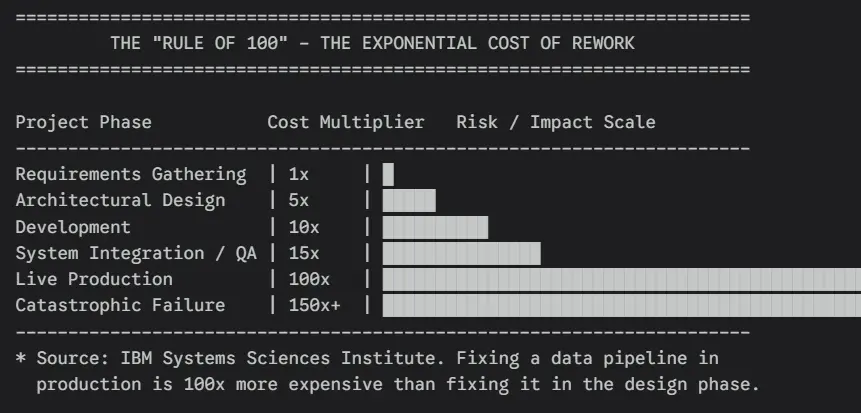
The Systems Sciences Institute at IBM established the “Rule of 100,” which demonstrates that a software bug or data anomaly fixed during the initial design phase is approximately one hundred times cheaper to resolve than the exact same defect identified after it is deployed into production.
Here is what the “Cost of Rework” multiplier actually looks like for your business:
If you need a concrete example of what happens when governance and quality is bypassed for speed, look at Samsung Securities. A simple “fat-finger” data entry error was pushed directly to production because the architecture lacked automated range checks and anomaly detection. In merely 37 minutes, the company inadvertently issued $105 billion worth of phantom equity shares, ultimately costing the enterprise an estimated $300 million in direct financial losses. Three months later the CEO resigned.. Three days after the regulatory filing resulting in the fines.
The Psychological Toll: Moral Injury and Imposter Syndrome
The financial penalties of rushed deployments are staggering, but the psychological toll on senior engineering talent is equally devastating.
Highly skilled professionals are continuously forced to bypass their fundamental professional standards, which initiates a deeply destructive process.
Originating in the medical and military professions, this is known as “Moral Injury”.
When you are forced to build fragile systems using massive amounts of technical debt simply to meet a political or arbitrary deadline, a severe internal conflict arises. You begin to falsely attribute the flawed outputs to your own perceived lack of ability, rather than the systemic corporate constraints. This is the root cause of the Imposter Phenomenon among tech professionals. You feel like a fraud because you are forced to ship work that completely fail to reflect your actual expertise.
The Gambill Framework: How to Push Back
When the pressure mounts, you cannot respond with standard technical pushback, which often escalates the situation. You must utilize communication pivots to shift the stakeholder from a primitive state of emotional urgency (the limbic system) to a state of analytical risk assessment (the neocortex). As my wife, a PhD and 28+ year therapist says “sometimes, you have to get them out of their feelings”. Here is how to do that in a professional setting:
Pivot to Loss Aversion: People experience the pain of a loss significantly more severely than an equivalent gain. Reframe the conversation from the “gain” of a faster release to the “loss” of a catastrophic enterprise failure.
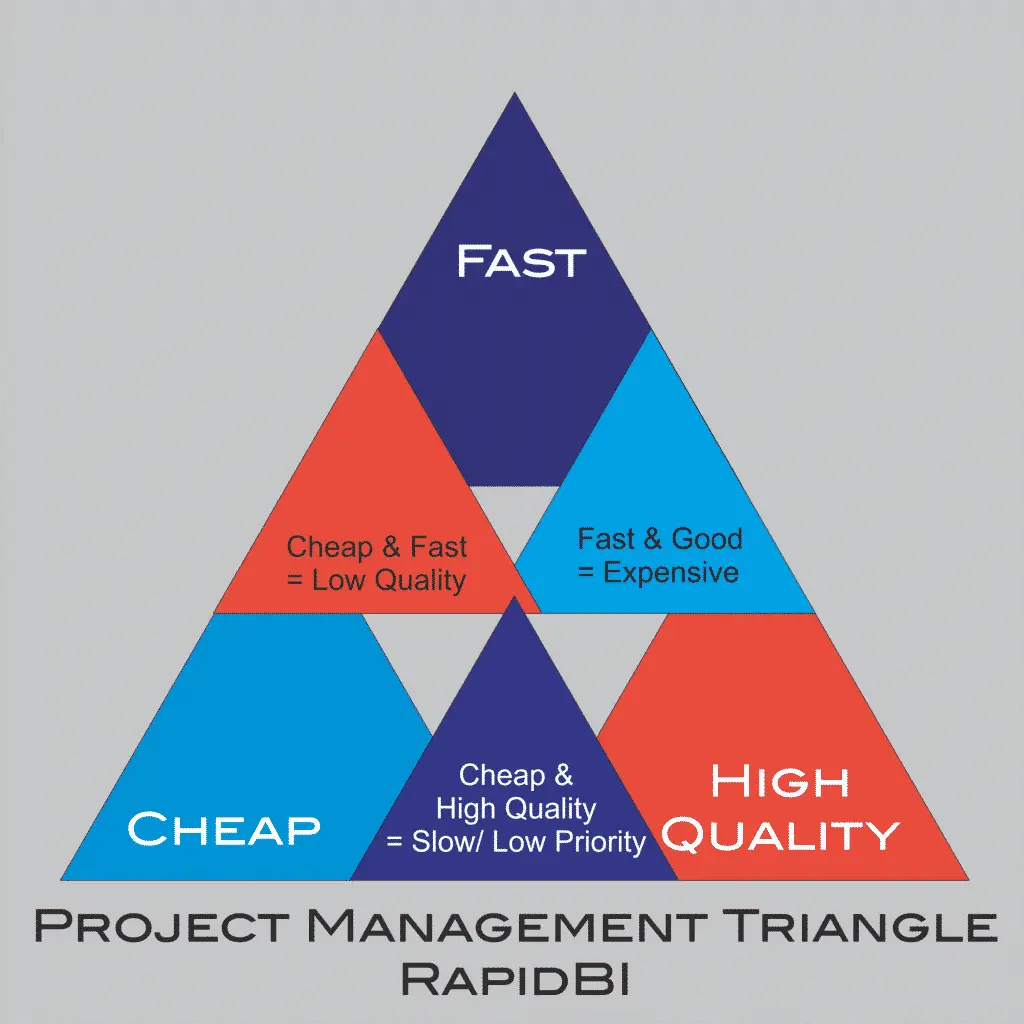
Enforce the Iron Triangle: Project quality is strictly constrained by Time, Cost, and Scope. If an executive aggressively mandates a reduction in Time, force an analytical trade-off: they must either drastically reduce the Scope or massively increase the Cost.
The Reality of “No Choice” (The Political Reality)
Let’s step out of the theoretical ivory tower for a second. We all know there are Friday afternoons where a stakeholder demands a bypassed-QA delivery not because of market forces, but because of internal political maneuvering. Sometimes, a VP just needs a win on their dashboard by Monday morning to appease the CEO.
As an internal employee, you don’t always have the leverage to say “No.” If you are forced to compromise the process, your goal shifts immediately from prevention to risk transfer.
You must clearly, dispassionately present the business with the trade-off they are forcing in writing. You are handing the liability directly back to them.
“I will deliver the dashboard by Monday at 8:00 AM. However, to meet that timeline, I have to bypass our standard Validation and QA protocols. Because of this, I cannot guarantee the accuracy of the underlying data, and the business assumes a high risk of calculation errors. Please confirm this is the approved path.”
This forces executive accountability. If the pipeline collapses on Tuesday, it isn’t a failure of your engineering. It is the documented cost of their requested speed.
The Mark of True Seniority: Architecting Reality
The next time you find yourself staring at a screen at 2:00 AM, weighing the cost of a bypassed QA cycle against the wrath of an impossible Monday morning deadline, remember this: Your job is not to say “yes” to every demand. Your job is to engineer reality.
A dashboard built on a fragile, unvalidated foundation isn’t a solution; it is a ticking time bomb. The executives demanding speed today will be the exact same executives demanding accountability when the numbers are wrong tomorrow.
True seniority in data engineering isn’t measured by how many hours you can stay awake, or how fast you can push raw code to production. It is measured by your capacity to govern the chaos. It is the backbone required to look at a room full of panicked stakeholders and say, “I get the urgency, but I can not compromise the integrity of our company data.”
Build your data team with the foundation that: We don’t just build pipelines; we build data assets the business can trust. That trust, by the way, is earned through rigorous governance, unapologetic boundaries, and a refusal to negotiate with terrorists… I mean the Iron Triangle.
Remember, if you are fighting these battles, feeling the pressure, and insisting on doing things the right way despite the pushback, you aren’t an imposter. You are the engineer holding the enterprise together, and you are not alone.
Stop measuring your worth by your speed. Start measuring it by the disasters you prevent.
Build Your Foundation (And Join Me in Nashville)
Unsure about how to word that email. I’ve got you.
1. The Risk Transfer Email Template: A clearly worded email removing the emotion and stating just the facts, providing options and a paper trail if anything goes sideways. [Google Doc Download]
2. The Databricks Deep Dive (March 6-7, 2026): If you want to see me in action, I’ll be in Nashville for the DataTune Conference at Belmont University. (20% off with the Gambill20 discount code)
March 6th: I am leading a full-day, hands-on workshop: “Modernizing Your Databricks Engineering: Using Lakeflow & Declarative Pipelines.” We will be getting into the weeds of building the exact metadata-rich foundations we discussed today.
March 7th: Join me for our session on “Adapt or Be Automated: Continuous Learning in the Age of AI and Data Engineering”. We will explore why adaptability is the most critical skill in the AI era. You’ll learn how to evaluate new technologies, when to embrace the latest innovations (like generative AI for pipeline automation), and when to stick with proven practices

Build data assets the business can trust. See you in Nashville.