Earlier this week, I decided to run a thought experiment. I posed a single, deliberately provocative question to a team I was meeting with, and then dropped the exact same scenario into the Practical Data Community and the Gambill DataSphere Discord:
“What would happen if the business came to you tomorrow and mandated that you can only use 1/3 of your current AI token usage?”
The reactions were an interesting study in technological psychology. In the room, one person outright rejected the premise. They argued that leadership would never enforce such a strict mandate, rendering the hypothetical irrelevant. It is a common defense mechanism in tech: the normalcy bias. We assume the current operating conditions will last forever.
But out in the community, those of us that have been around, saw the writing on the wall.
, author of Fundamentals of Data Engineering, hit the nail on the head almost immediately: “It will happen... assuming the ROI isn’t there with 3x the tokens.” He pointed out that data teams already struggled with cost management in the pre-AI days. Now, autonomous agents are compounding the challenge, driving both compute and token budgets sky-high.
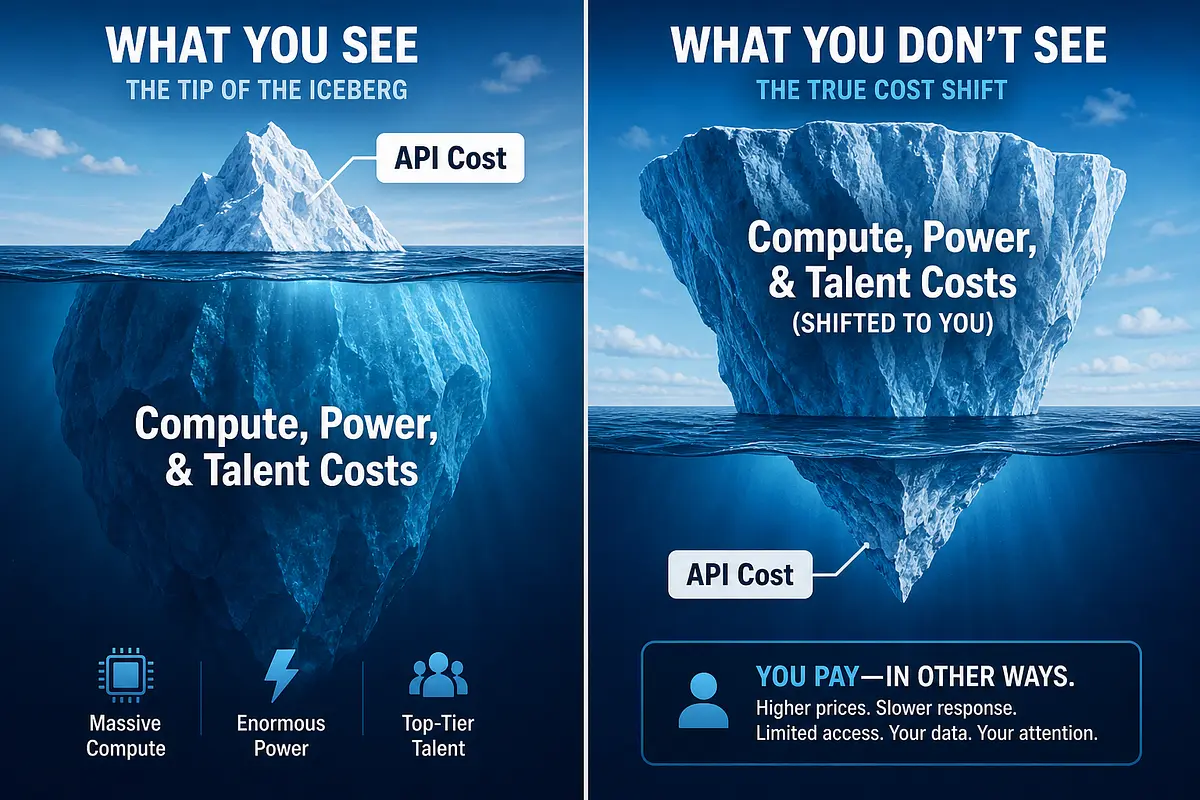
If you are ignoring the possibility of an impending token squeeze, you are making a dangerous gamble. We are not living in an AI bubble that is about to pop; the technology is far too valuable. Instead, we are living in a brief, anomalous era of heavily subsidized compute.
And that expiration date is rapidly approaching.
The Illusion of Cheap Compute and the “Subsidy Scam”
Right now, the generative AI industry is operating a bit like a cartel. The first hit is artificially cheap.
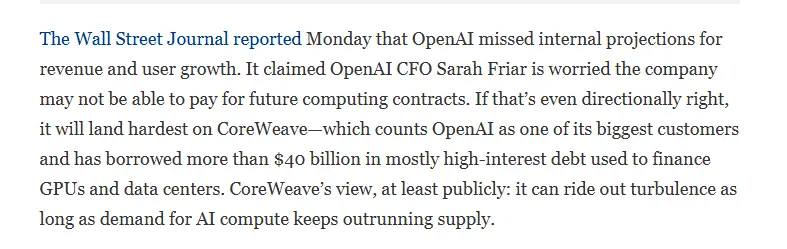
For the past few years, the venture-subsidized model has allowed developers and enterprises to consume compute at a fraction of its actual cost. We have been shielded from the true unit economics of foundation models. But when you look at the raw financial data from the first half of 2025 and into 2026, this “subsidy scam” reveals itself to be entirely unsustainable.
Consider the math:
The flagship provider in the space hit an incredible $4.3 billion in revenue in early 2025, but simultaneously posted a staggering $13.5 billion net loss.
That translates to a daily cash burn of over $13.8 million per day.
In the B2B space, Microsoft was reportedly losing an average of $20 per user monthly on the $10/month GitHub Copilot plan… with heavy power-users costing the company up to $80 a month.
At one point, Anthropic was allowing users to burn roughly $8 in compute for every $1 they spent on subscription fees.
We are already seeing the consequences of this cost correction. A recent TechBrew article captured this shift perfectly with its headline: “AI makes human labor look cheap again.”
The era of reckless tech spending used to be defined by private jets or lavish dinners; today, it is defined by $113,000/month API invoices. Companies are actively reaching a tipping point where autonomous AI agents are becoming more expensive than the engineers they were meant to assist. According to the report, Uber has already burned through its entire 2026 AI budget, and an Nvidia executive admitted that their team's compute costs now far exceed their actual employee payroll. Why? Because agentic workflows—where AI loops and self-corrects—are burning compute at an unsustainable rate. The venture capital subsidies are ending. If your architecture relies on brute-forcing logic with expensive LLMs rather than utilizing human judgment and optimized compute engines, your operating margins are about to collapse.
We are already seeing the market correction begin. Copilot has transitioned toward usage-based pricing models, and enterprise API providers like Zhipu AI spiked their token prices by 83% earlier this year. The true cost of compute is beginning its inevitable trickle-down to the end-user.
The Margin Crusher: Tokenmaxxing and the XXL Warehouse
The impending danger isn’t simply that AI will become more expensive; the danger is how addicted our engineering cultures have become to using it lazily. (And how some now only know work-life with AI)
Because tokens have been virtually free, we have bypassed the hard work of system design. Another user on the PDC Discord summarized the current state of engineering perfectly:
“We need better tooling for adaptive token usage. I pretty much use Opus 4.6 for every task, which is clearly overkill. It’s like using an XL warehouse to run simple queries.”
That analogy is perfect because we have seen exactly how this plays out in the modern data stack. I recently had a discussion with a peer about a Snowflake bill that jumped from $10,000 to $83,000 in a single month. The root cause? An engineer bumped a warehouse from XS to XXL to run a quick, heavy task for the marketing team, forgot to turn the schedule off at the end of the week, and accidentally routed all the team’s daily ETL through that XXL warehouse for two weeks straight.
We are making the exact same architectural mistakes with LLMs.
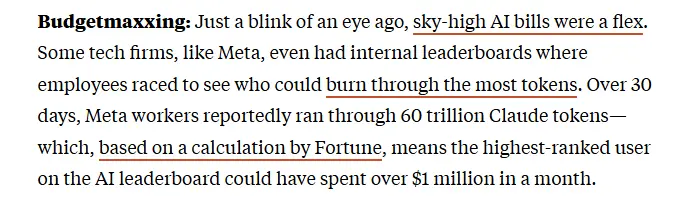
We are suffering from a culture of “tokenmaxxing”… using the heaviest, most expensive foundation models as a brute-force tool for simple syntax generation, JSON parsing, or basic data mapping.
Tokenmaxxing - using the heaviest, most expensive foundation models as a brute-force tool for simple syntax generation.
The financial threat is magnified by the underlying mechanics of LLMs. Transformer architectures suffer from quadratic scaling. As your context window grows, the compute required to process it doesn’t scale linearly; it scales exponentially. If you pass a massive, messy, ungoverned dataset into an LLM and ask it to “figure out the logic,” you are paying a massive premium for the model’s attention mechanism to sort through the noise.
The Next Explosion: Agentic Loops
As we move deeper into 2026, the reliance on single-prompt syntax generation is evolving into multi-agent workflows. This is where the token squeeze will become lethal for poorly designed systems.
Joe warned about this in his response to the thought experiment: “Data teams already had enough trouble with cost management in the pre-AI days. From what I’m seeing, agents are compounding the challenge in a very major way - compute and token budgets are both going sky high.”
When you build agentic loops… where a model drafts code, runs it, reads the error, self-reflects, and retries multiple times… you are burning tokens autonomously. A single complex task can now burn up to $11 in raw compute per session. If your architecture relies on agents brute-forcing their way through messy data environments without guardrails, your cloud bill will look like that runaway XXL warehouse, but multiplied by a factor of ten.
If a 66% mandate cut in your token budget breaks your deployment pipeline or brings your engineering velocity to a grinding halt, you don’t just have a budget problem. You have engineering rigor and fundamental architecture problems.
The Antidote: Strategy Over Syntax
The companies that survive the impending cost correction won’t be the ones that abandon AI. They will be the ones that are already conscientious of their usage. As Nav pointed out in the Discord, businesses always look for ROI. If they see tokens being wasted on inefficient workflows without effective outcomes, they are going to cut them.

The defense against rising AI costs requires a return to rigorous engineering discipline. The mantra for survival is simple: Strategy over Syntax.
We must shift away from relying on AI to generate complex business logic dynamically, and return to active, configuration-driven architectures. Whether you are managing massive network telemetry streams in telecom, parsing threat vectors in cybersecurity, or optimizing complex supply chains in manufacturing and aviation, the core principles remain the same.
Your business logic needs to live in tightly governed, version-controlled metadata, not in the expensive ether of an LLM prompt.
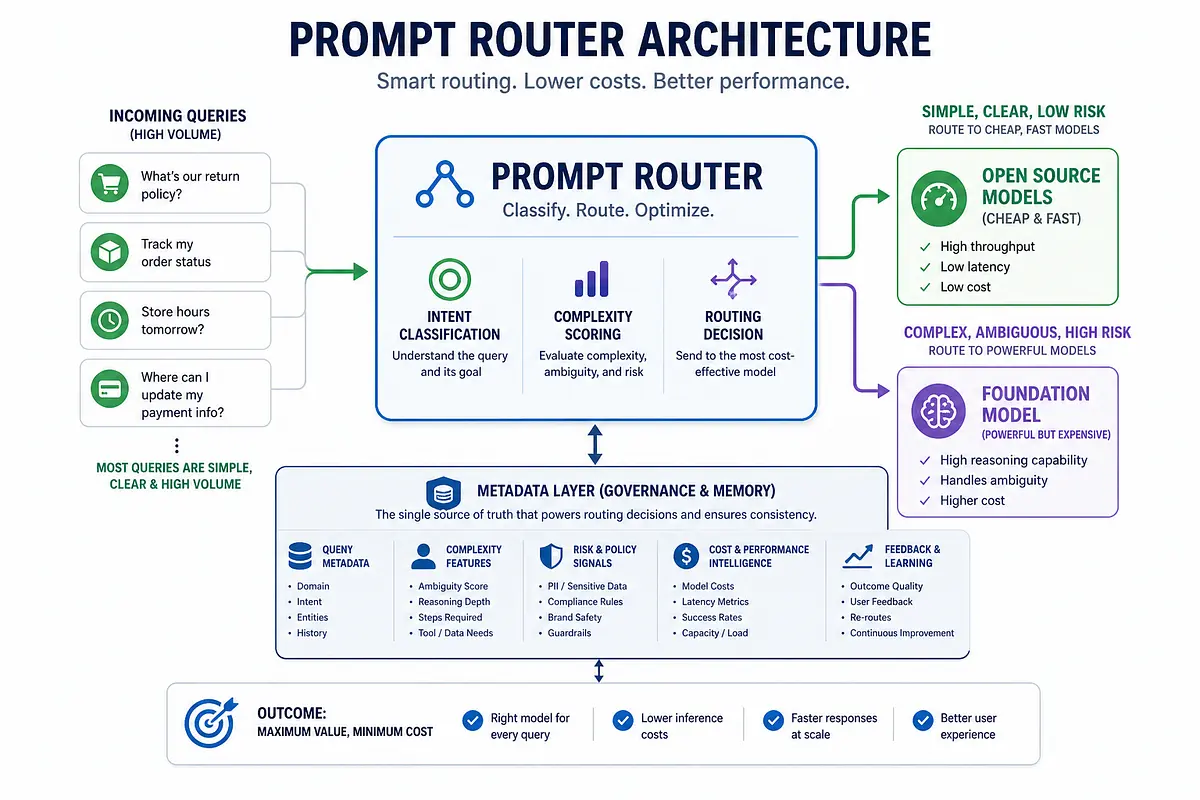
Kyle Shannon echoed this perfectly in his response, noting that the honeymoon is ending. “It’s important to have observability into the traces and usage with metadata... Model routers, open source models for repetitive easier tasks.”
In this new era of AI rationing, metadata is no longer just “data about data”; it is the connective tissue that tells AI systems how to behave.
If you are operating within a unified analytics platform like Databricks, the blueprint for this is already available. A well-structured Medallion Architecture ensures that raw data is systematically refined, audited, and aggregated. By utilizing tools like Unity Catalog for active metadata management and Declarative Automation Bundles (DABs) for deployment, you create a semantic layer that gives models precise context.
Instead of passing raw, unoptimized data to an expensive Opus or GPT model to figure out, you route highly specific, pre-filtered metadata to smaller, cheaper, open-source models. You use the LLM to orchestrate the configuration, but the heavy lifting of the data processing remains in your optimized compute engines. You decouple the logic from the LLM, making your systems predictable, scalable, and insulated against API price hikes.
The “Build to Break” Test
This thought experiment isn’t just about hypothetical budgeting. It is a necessary “Build to Break” exercise for your data teams.
As Taran mentioned, enforcing a sudden, massive reduction in token limits would definitely cause a collective “oh come on” moment across the engineering floor. But constraints breed innovation. It would fundamentally force teams to be more mindful of their resource consumption.
If you artificially constrain your resources today, you quickly expose the lazy dependencies in your system design. You find out exactly where you are using AI as an architectural crutch rather than an accelerant.
The era of infinite, cheap tokens is ending. The subsidy is expiring. But the engineers, architects, and technical leaders who prioritize efficiency, metadata management, and responsible AI routing today won’t have to panic when the market corrects itself.
They are already building the resilient, cost-effective systems of tomorrow.
Build AI Systems That Don’t Collapse Under Their Own Token Bill
AI is not going away.
But the companies that win with it will not be the ones blindly throwing bigger models at every problem and hoping the invoice behaves itself. That strategy works right up until finance opens the cloud bill and starts asking uncomfortable questions.
The real advantage will come from better architecture:
Governed metadata
Clear human-in-the-loop decision points
Model routing
Cost observability
Strong data foundations
Practical automation boundaries
Business logic that lives somewhere more reliable than a 40,000-token prompt
That is the difference between using AI as an accelerant and using it as a very expensive architectural Band-Aid.
If your team is trying to figure out where AI belongs in your data architecture, where humans still need to own decisions, or how to build governance around agentic workflows, this is exactly the kind of work we help with at Gambill Data.
Download the AI Autonomy Decision Tree to help your team decide when AI should automate, when it should assist, and when a human needs to stay firmly in the loop.
Need help applying this to your data platform, governance model, or AI strategy? Schedule a strategy session now!
And if you’re a data professional trying to build the skills to work in this kind of AI-ready architecture, I’ve got something for you too.
Breaking Into Data Engineering?
If you’re stuck in tutorial hell, applying to role after role, and still getting auto-rejected, the problem probably isn’t effort.
It’s positioning.
Hiring managers don’t need another certificate screenshot. They need proof that you can think through messy requirements, build something practical, and explain the business value behind the technical work.
That’s why I built the Gambill Data Coaching Project Creator.
It takes your resume, a 15-question skills assessment, and the job postings you actually want, then turns them into a custom portfolio project charter built around the skills you need to close the gap.
No generic “build a dashboard” nonsense. No recycled tutorial project everyone else has already copied.
You get:
A personalized data engineering project charter
Job-posting-targeted requirements based on 1–3 roles you want
A milestone tracker with implementation steps
Exportable PDF, DOCX, and Markdown versions for your portfolio
Projects designed around SQL, cloud, architecture, production readiness, and business strategy
Each project is built to be completed in 4–8 weeks part-time, uses free public datasets, and maps technical work to business outcomes you can actually talk about in an interview.
Base plan: $50/month
Optional coach feedback add-on: $49.99/month, which includes 2 milestone feedback requests per month from a real coach.
Your next interview story should not be, “I finished another course.”
It should be:
“Here’s the project I built, why I designed it this way, and how it solves a real business problem.”
Start building with the Gambill Data Coaching Project Creator.