They Call It Fear-Mongering. I Call It a Weather Report.
This week, the comments on my latest video got heated. One person explicitly called me out for “fear-mongering.” Their argument was that by pushing juniors to look beyond the basics and tackle advanced concepts early, I was creating unnecessary anxiety. They claimed I was making Data Engineering seem scarier than it is.
Let’s get one thing straight.
Describing a storm isn’t fear-mongering. It is a weather report.
If I tell you that a hurricane is coming, I am not trying to scare you. I am trying to get you to board up your windows. If you choose to ignore it because the reality feels “too negative,” that is your choice. But when the roof blows off, don’t blame the weatherman.
The reality of the Data Engineering market in 2025 is not a calm, sunny day where knowing SELECT * FROM gets you a six-figure salary. Also, please don’t just use SELECT * … The reality is that hiring managers are terrified of technical debt, AI is raising the bar for code quality, and the “easy” jobs are evaporating.
Calling this “fear-mongering” is a defense mechanism. It’s a way to opt out of the hard work required to survive.
Where The Rubber Hits The Road
I want to tell you about one of my coaching clients. Let’s call him Joe.
Joe works a job that requires 7-day weeks in a secure facility where he can’t even bring his car keys inside. He wakes up at 4:00 AM to study before a grueling shift. He is the definition of grit.
But this week, he hit a wall.
He walked into a technical interview for a Data Engineering role. He was ready to talk about pipelines, transformation, and delivery. Instead, he interviewed with SWEs that grilled him on abstract, Object-Oriented Programming (OOP) concepts, the kind of over-engineered “software theory” that 80% of data engineers will never touch in production.
He failed the interview. He felt crushed. He felt like all that 4:00 AM effort was wasted.
It would be easy to tell Joe: “That interview was unfair. Those guys are gatekeepers. Just stick to the basics.”
But that won’t get Joe hired. And it won’t help you.
The $12.9 Million Reason Why “Easy” is Over
Why are interviews becoming so brutally difficult? Why are companies demanding “Senior” skills for mid-level roles?
It isn’t because they are mean. It is because they are under constant scrutiny from the rest of the business to deliver, and under pressure from the CFO to deliver under budget.
Research from Gartner indicates that organizations lose an average of $12.9 million annually due to poor data quality. This isn’t just a typo in a spreadsheet; it is revenue leakage, failed AI models, and operational chaos.
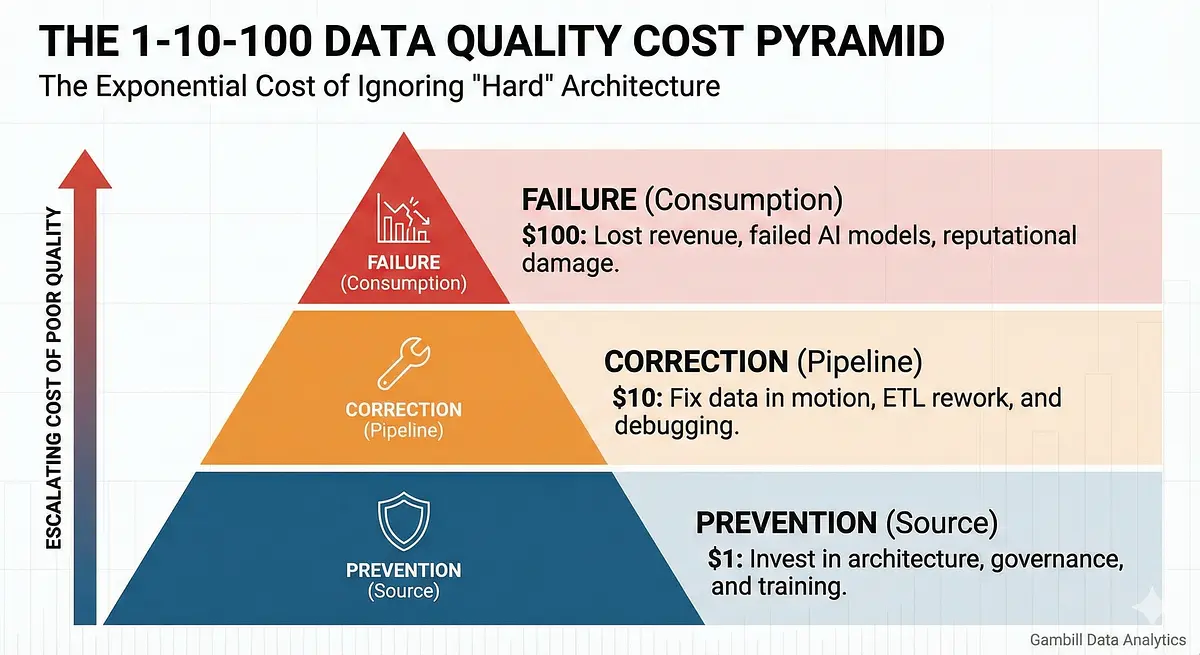
This financial hemorrhage follows the “1-10-100 Rule” of data quality:
$1 to fix a problem at the source (Prevention).
$10 to fix it in the pipeline (Correction).
$100 to fix it once it hits the dashboard (Failure).
When a “bootcamp grad” who only focused on the “basics” builds a pipeline, they often introduce errors that cost the company 100x to fix later. Hiring managers know this. They are terrified of the “Hidden Technical Debt” that comes from opaque, AI-generated code and inexperienced architecture.
They aren’t testing you on obscure Python concepts to be annoying. They are testing you to see if you are a $1 asset or a $100 liability.
The Science of “Desirable Difficulties”
This brings us back to the advice that you should “avoid overwhelm.”
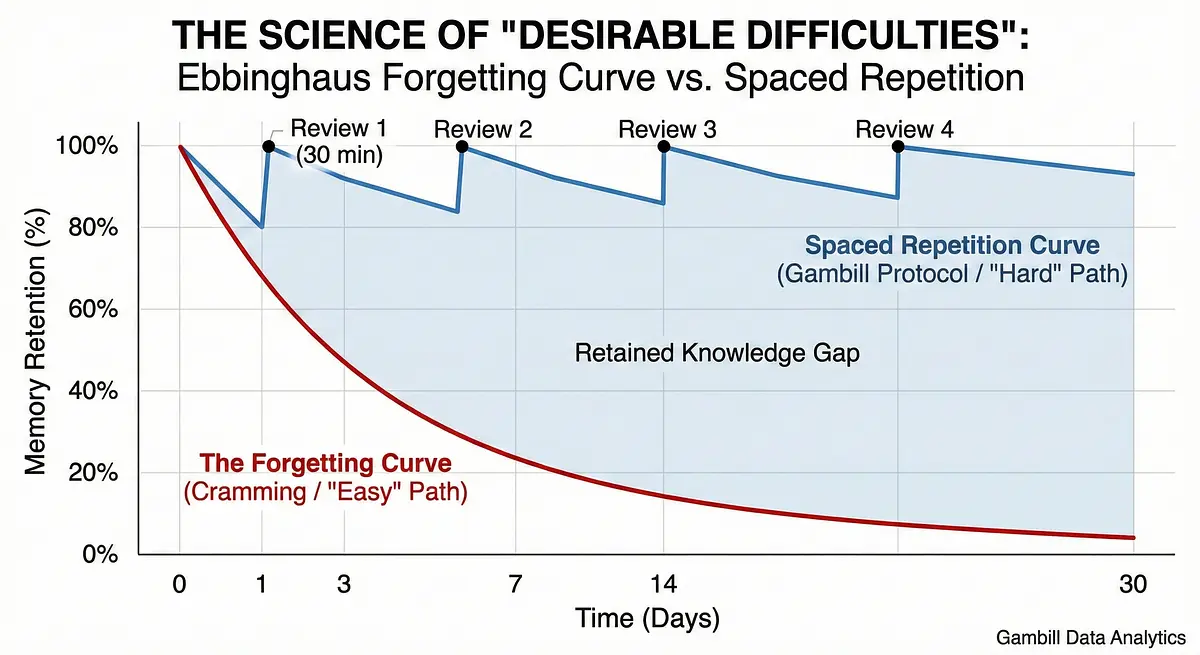
Cognitive science tells us that this is exactly the wrong way to learn. Researchers Robert and Elizabeth Bjork coined the term “Desirable Difficulties”, learning conditions that make the immediate task harder but dramatically improve long-term retention.
When you follow a step-by-step tutorial or let Claude write your code, you are removing the struggle. You are creating an “Illusion of Competence”. You feel like you know it because the code runs.
But you haven’t built the neural pathways (schemas) to solve the problem when the tutorial isn’t there. You have bypassed the Germane Cognitive Load, the mental effort required to actually store information in long-term memory.
Resilience is a technical skill. When you wrestle with a compiler error for an hour, you aren’t wasting time. You are encoding the solution into your brain. When you avoid that struggle, you remain fragile.
The 30-Minute Compound Effect
So how do you become unbreakable without burning out? You don’t do it by cramming for 12 hours. You do it by picking your “hard” every single day.
Scientific research on Spaced Repetition shows that spacing study sessions over time improves retention by up to 80% compared to massed practice (cramming).
Here is the Gambill Data Protocol:
Pick one “Hard” thing. (e.g., Python Memory Management, Spark Optimization, Delta Lake Internals).
Spend at least 30 minutes on it. No distractions. No “coping” with AI.
Repeat daily.
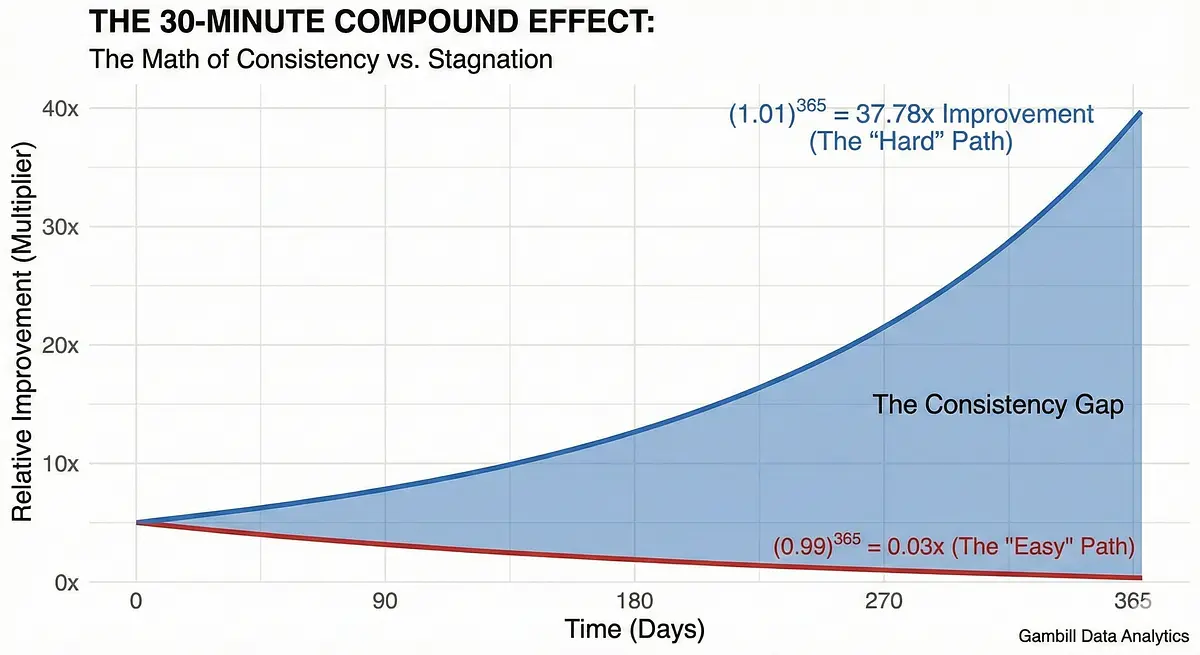
This leverages the compounding effect. An engineer who learns one new architectural pattern a day possesses 365 robust patterns after a year. An engineer who relies on “just-in-time” Googling possesses zero.
Get Up. Move Forward.
“Joe” is back at it. He’s tired. He’s frustrated. But he’s moving. He is shifting his focus from “making it work” to “understanding why it breaks.”
A year from now, you will look back at this moment. You will either see the growth born from the small, difficult steps you took when you were “overwhelmed,” or you will see the regret of the excuses you made to stay safe.
We need to build data that is ready for AI. We need pipelines that are resilient. But first, we need engineers who are Unbreakable.
Pick yourself up. Go again.