The Ghost of 1998
If you know anything about college football, the year 1998 carries a certain mythological weight, especially in East Tennessee. It was a year of absolute execution, relentless pressure, and a level of national scrutiny where even the smallest operational error could derail a championship run.
I didn’t experience that legendary season from the comfort of a luxury box or the rowdy center of the student section. I experienced it from the grass. As a UT student manager, and especially working with the kickers, my world was measured in logistics, precision, and the invisible infrastructure that allows elite athletes to perform at maximum scale.
When you are standing on the sidelines of a stadium holding over 100,000 screaming fans, you learn very quickly that success is never accidental. It is the direct byproduct of preparation, rigorous governance, and a foundational workflow that removes friction before the team ever takes the field. My job wasn’t to play the game; my job was to ensure that the systems supporting the game never failed. If a kicking tee was misplaced, if a timeline slipped by thirty seconds, or if communication broke down between the coaches and the staff, the entire machine stuttered.
That environment was my first real introduction to large-scale operations. It was a crash course in understanding that the flashiest plays on television are entirely dependent on the unglamorous, highly disciplined framework operating backstage.
Fast forward nearly three decades. The tools I use today look entirely different. I’ve traded helmets, headsets and equipment trunks for cloud environments, compute clusters, and data lakehouses. But as the founder of Gambill Data, I find myself returning to those exact same operational principles every single week.
Because whether you are managing a football team on a historic championship run or architecting a multi-region data estate for a global enterprise, the core reality remains unchanged: If your underlying infrastructure cannot scale, your strategy is nothing more than a wish.
The Return to the Stands: A Lesson in Metamorphosis
Recently, I found myself sitting in those exact same Neyland Stadium stands, but this time, the view was entirely different. I wasn’t wearing a manager’s uniform, and I wasn’t pacing the sidelines. I was sitting next to my wife, looking down at a spectacle that would have seemed completely impossible back in 1998.
The Savannah Bananas had brought their Banana Ball World Tour to Knoxville.
For the uninitiated, seeing a baseball diamond mapped onto the sacred turf of an iconic SEC football stadium is a profound exercise in cognitive dissonance. And reminds me of the destoyed battlefield left behind after the Florida win at home in 1998 where chunks of the field were cut out of the ground and goalposts carried off by a sea of fans that had rushed the field.
Neyland Stadium was engineered for one specific, highly structured purpose: gridiron football. The dimensions, the sightlines, the seating arrangements, and the entire logistical pipeline of the venue were built to support 100 yards of intense, physical collisions.
Yet, there we were, watching a baseball team pack out a 100,000-seat football venue to absolute capacity.

Standard Stadium Configuration:
[ Legacy Gridiron Structure ] ──> Optimized for One Predictable Flow (Football)

The Banana Ball Paradigm Shift:
[ Dynamic Spatial Refactoring ] ──> Injecting High-Velocity Agility into a Rigid Environment
As a data architect, I couldn’t just turn off my brain and eat popcorn. I was fascinated by the sheer operational audacity of the event. The Savannah Bananas didn’t just rent a stadium; they completely refactored the environment. They rewrote the rules of baseball, introducing time limits, eliminating walks, turning fan catches into outs, all to maximize velocity, engagement, and entertainment value. They took a legacy environment, dropped an entirely new paradigm into it, and executed it flawlessly at a massive scale.
Watching the game unfold, it struck me that this is the exact challenge confronting almost every mid-market and enterprise business leader today.
Organizations are desperately trying to achieve their own version of “Banana Ball” speed and agility. Instead of fans catching balls they implement “citizen analysts” that create reports and even write SQL queries. They want to pivot instantly based on market conditions, deploy real-time analytics, leverage machine learning, and deliver hyper-personalized customer experiences. They want to be fast, fun, dynamic, and disruptive.
But when you look under the hood of these organizations, you find that they are trying to run this high-velocity future on top of rigid, fragmented, “1998-era” legacy data foundations. They expect their teams to perform like modern innovators while forcing them to operate within the structural constraints of the past.
The Infrastructure Paradox: Why Legacy Fails Under Modern Strain
Enterprise data teams do not fail because the developers lack talent or because the chosen tools are inherently bad. They fail because of a fundamental disconnect between business ambition and architectural reality.

When a company decides it wants to become “data-driven,” the typical playbook involves purchasing a suite of expensive visualization tools, building a few flashy dashboards, and declaring victory. This is the corporate equivalent of putting a Jumbotron in a stadium without bothering to construct a functional field beneath it. It looks impressive for a moment, but the second you try to run a high-volume play, the ground gives way.
Let’s look at the anatomy of a typical legacy corporate data estate. Over ten, fifteen, or twenty years, a business grows. It acquires new subsidiaries, adopts various SaaS platforms, and builds proprietary internal applications. Each of these systems generates data. Because there was no centralized architectural vision, individual departments began building their own point-to-point connections to move that data around without standards, governance, and consistency.
The result is what we call the Spaghetti Pipeline Architecture:
Fragile ETL Jobs: Unmonitored scripts running on local servers that break the moment a source system changes a single column name.
Data Silos: The finance team has their spreadsheet, the sales team has their CRM data, and the operations team has their inventory logs. None of these systems talk to one another, and no two reports ever match.
The Hero Dependency: A single, severely overworked DBA or engineer who is the only person in the entire company who knows how the legacy SQL server actually works. If they go on vacation or leave the company, the entire reporting infrastructure grinds to a halt.
The Brutal Truth of Modern Analytics: You cannot run a predictive, AI-driven business on a foundation of unmonitored CRON jobs (possibly run on a PC under someone’s desk) and undocumented Excel files. When you attempt to force modern analytics workloads through a fragile, fragmented pipeline, you don’t get insights. You get latency, inaccuracies, and operational panic.
When an executive team looks at a dashboard and realizes the data is three days old, or worse, completely incorrect, trust evaporates. The moment trust evaporates, the organization reverts to making multi-million-dollar decisions based on “gut feel” and intuition.
The manual processing, the endless reconciliation meetings, and the constant firefighting represent a massive, ongoing drain on corporate productivity. It is a hidden tax that businesses pay every single day because they refuse to modernize their core infrastructure.
The Architecture of Scale: Engineering the Enterprise Standard
At Gambill Data, our core mantra is simple: We don’t just build pipelines; we build data assets that the business can trust. We do not approach data engineering as a series of disconnected coding tasks. We approach it as enterprise architecture. When we design a solution for a client, we are building a centralized, governed, and highly scalable engine designed to turn raw data into a reliable competitive advantage.
To achieve this, we align our practice with industry leaders in modern data architecture. We do not gamble our clients’ operational stability on unproven, niche open-source projects or hyper-hyped tools that won’t exist in three years. We build on battle-tested platforms that are engineered explicitly for enterprise scale.
1. The Definitive Standard: Databricks and the Lakehouse Architecture
For organizations facing massive data volumes, complex machine learning workloads, or high-velocity data streaming, Databricks is our premier recommendation.
For decades, organizations were forced to choose between two distinct data paradigms: the data warehouse (optimized for structured business intelligence but rigid and expensive) and the data lake (capable of storing massive amounts of unstructured data but notoriously difficult to query and prone to becoming an ungoverned “data swamp”).
Databricks solved this paradox by inventing the Lakehouse Architecture, powered by Delta Lake. This approach unifies the best elements of both worlds, providing the reliability, ACID transactions, and governance of a data warehouse directly on top of scalable, cost-effective cloud object storage.
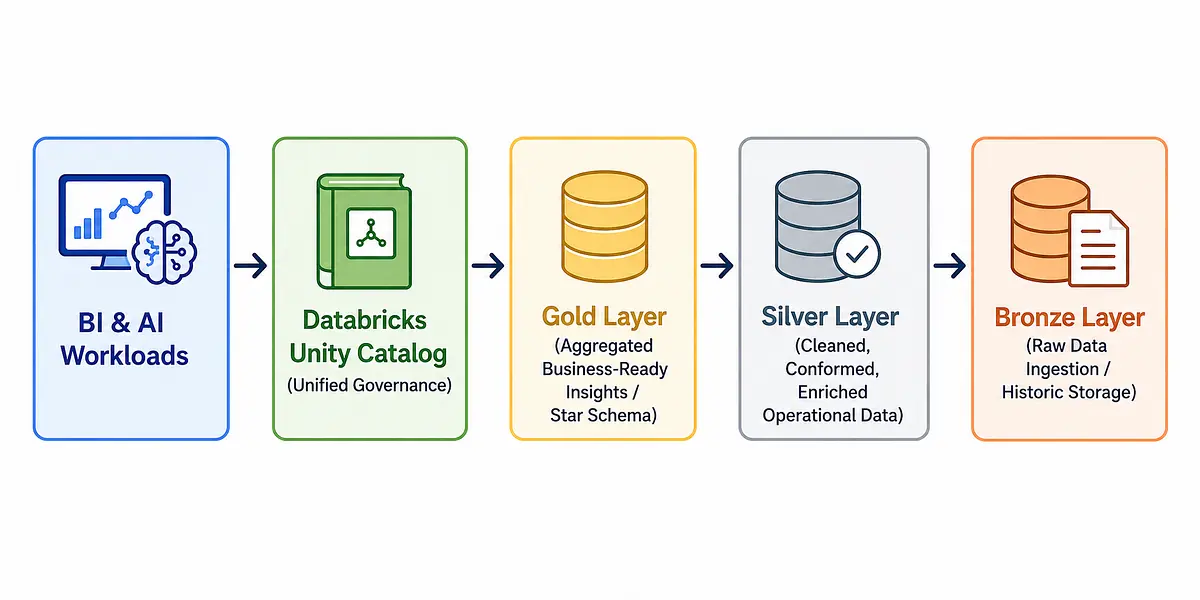
When we implement Databricks for our clients, we deploy a standardized, highly disciplined framework known as the Medallion Architecture:
Bronze Layer (Raw Data): We ingest data from every corporate source system in its native format. This provides an unadulterated, historical record of the business. If a pipeline ever needs to be rebuilt or reprocessed, we always have the raw source truth preserved.
Silver Layer (Enriched Data): In this layer, we clean, conform, deduplicate, and enrich the raw data. We apply strict schema validation and quality checks. The Silver layer represents the clean, unified operational reality of the entire enterprise.
Gold Layer (Business-Ready Insights): This is where data is aggregated and optimized for consumption by business analysts, executive dashboards, and machine learning models. It is structured for performance, ensuring that a CEO can open a report and get an instant, accurate answer without waiting for hours for a complex query to run.
By separating compute from storage and utilizing Databricks’ optimized execution engine, we allow businesses to process petabytes of data with sub-minute latency. More importantly, we wrap this entire ecosystem in Unity Catalog, providing a single, comprehensive governance layer that tracks data lineage from source to dashboard, ensuring absolute regulatory compliance and security.
2. The Integrated Ecosystem: Microsoft Fabric
While Databricks serves as a heavy-duty, high-scale analytics engine, many mid-market organizations operate deeply within the Microsoft ecosystem. For these organizations, Fabric offers a highly compelling alternative.
Microsoft Fabric consolidates data engineering, data warehousing, data science, real-time analytics, and BI into a single, cohesive Software-as-a-Service (SaaS) platform. Built entirely on top of OneLake. Fabric reduces the need for complex, manual integration of disparate cloud services.
However, Fabric’s accessibility can be a double-edged sword. Because it is incredibly easy to provision and use, untrained teams often jump in and begin building pipelines without an architectural blueprint. Without rigorous oversight, Fabric can quickly become a highly accelerated version of the same old chaotic legacy systems, just hosted in a newer, shinier cloud environment.
When Gambill Data implements Microsoft Fabric, our primary focus is establishing Ironclad Governance. We ensure that:
Workspace Topologies are logically segmented to prevent cross-contamination between development, staging, and production environments.
OneLake Shortcuts are leveraged correctly to minimize data duplication and eliminate unnecessary data movement costs.
Semantic Models are centrally defined and certified, ensuring that every Power BI report across the entire global enterprise pulls from the exact same business logic.
We don’t view Databricks and Microsoft Fabric as mortal enemies; we view them as distinct, powerful tools optimized for specific organizational profiles. Our job is to evaluate your current technical debt, your team’s existing skill sets, and your long-term business goals, and then architect the specific platform combination that delivers maximum return on investment while ruthlessly minimizing technical risk. We are a big proponent of picking the right tools and method for the workload. You don’t use a hammer on a screw and you don’t use a screwdriver on a nail (though some might try.)
The Core Philosophy: Moving Beyond Pipelines to Trust Assets
The technical specifications of modern data engines are fascinating to architects like myself, but they mean absolutely nothing to an executive team if they do not solve a concrete business pain.
At the end of the day, business leaders do not buy technology stacks. They do not care about Spark clusters, delta logs, or parquet files. What they are actually buying when they partner with a premium consultancy is risk reduction and certainty.
Think about the sheer amount of friction embedded in the daily life of an average corporate executive. They are asked to make massive, high-stakes decisions, entering new markets, adjusting supply chains, altering pricing models, while looking at data they secretly suspect is flawed. They are operating in a state of permanent operational anxiety.
When we transform a chaotic data mess into a highly governed enterprise asset, we are changing the psychological reality of the business.
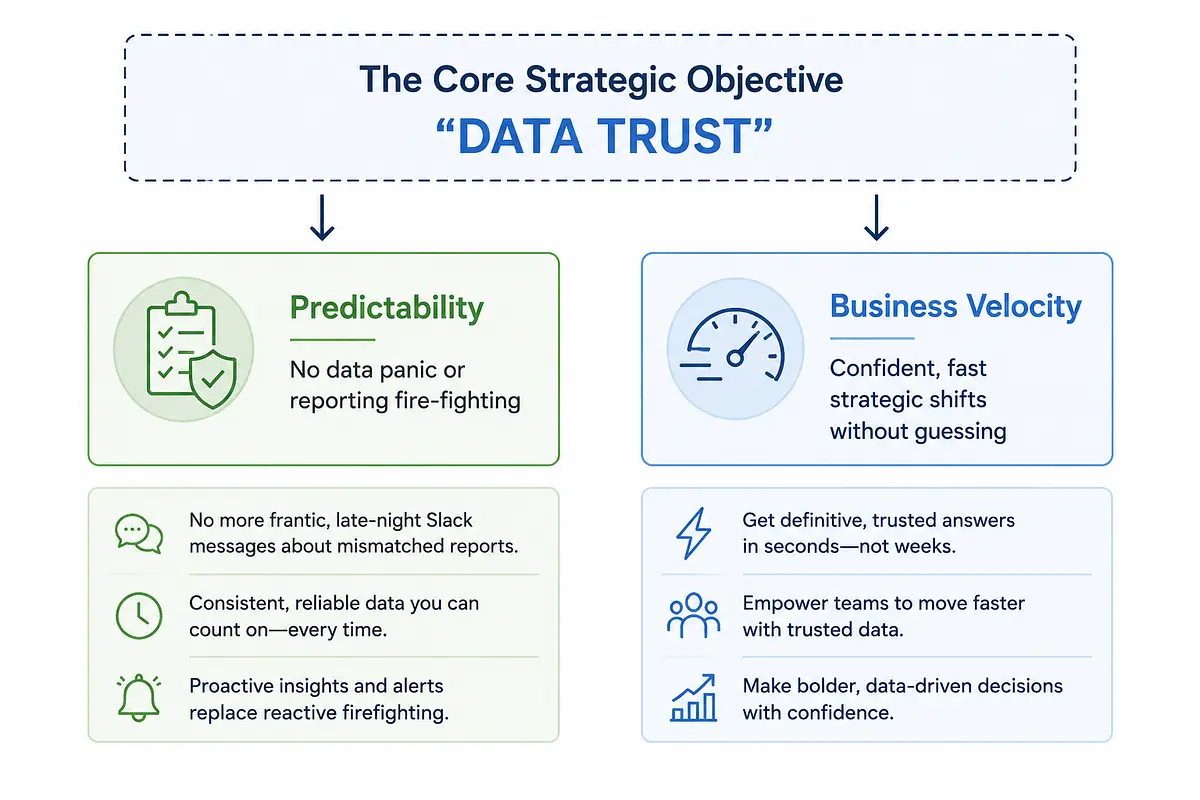
Predictability replaces panic: There are no more frantic, late-night Teams messages asking why the sales dashboard doesn’t match the accounting report.
Velocity replaces hesitation: Instead of spending three weeks manually gathering and validating data from six different departments to analyze a market trend, leadership can query a centralized Gold layer in Databricks or Fabric and get a definitive, trusted answer in seconds.
True Automation becomes possible: Regulatory reporting, compliance audits, and inventory forecasting transition from labor-intensive, manual chores into automated, self-healing background processes.
This is what we mean when we talk about a Data Asset. A pipeline is just a piece of code that moves text from point A to point B. An asset is a structured, permanent piece of corporate infrastructure that actively appreciates in value over time, lowering your operational costs and maximizing your strategic options.
The Continuous Line of Operational Excellence
Looking back at that 1998 season from my current vantage point as a data consultant, the connection between the football field and the enterprise cloud feels completely seamless.
The Savannah Bananas succeeded at Neyland Stadium because they understood how to adapt a legendary, rigid structure to meet a highly dynamic, modern objective. They respected the scale of the venue, but they completely reimagined how to utilize its space.
That is exactly what we do for businesses. We don’t tell you to throw away your historical data, fire your existing teams, or abandon your core corporate logic. We help you refactor your operational environment. We take the valuable institutional knowledge trapped inside your legacy systems and teams and help them mature into the foundation of a modern, scalable architecture required to unleash your true potential.
The playbook for business velocity has completely changed over the last three decades. The days of relying on fragmented reporting, manual workarounds, and gut-feeling decision-making are officially over. If your current data infrastructure is holding back your business, forcing you to move slow when the market demands you move fast, you are operating at a massive, unsustainable disadvantage.
Success, whether on a football field or inside a cloud data warehouse, always comes down to the exact same fundamentals: preparation, a reliable infrastructure, and a foundation built to last.
Take Control of Your Data Asset
Stop fighting legacy fires, tolerating three-day-old reports, and making multi-million-dollar decisions based on gut feel. Your organization deserves an infrastructure that matches its ambition.
Let’s stop guessing and start building. Book a strategy call with Gambill Data today, and let’s transform your data from an operational risk into a trusted asset engineered for the future of your business.
About the Author
Chris Gambill is the Principal Architect and Founder of Gambill Data, a premium data consultancy that engineers trusted, enterprise-grade data assets for mid-market and enterprise organizations.
Before spending the last 25+ years architecting cloud infrastructure and providing fractional data leadership to mid-market and enterprise organizations, he got his operational start managing logistics on the sidelines for the 1998 UT National Championship football team.
Today, he combines that foundational respect for operational discipline with deep technical expertise in Databricks and Microsoft Fabric to help companies eliminate technical risk, improve business velocity, and build data systems they can actually trust.