Gen AI has fundamentally changed the cost of writing code. It has done absolutely nothing to change the cost of owning a data architecture.
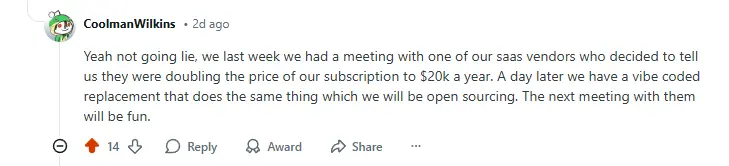
Right now, enterprise executives are celebrating because their developers are “vibe coding” custom replacements for $20,000 SaaS licenses in a single afternoon. They are using AI to stitch together brittle Airflow DAGs, generate superset dashboards, and write undocumented custom connectors just to avoid a vendor consumption fee.
It feels like a massive cost-saving victory, and delivers an architectural disaster.
Here is the brutal truth of the AI era, the cost of creation has plummeted, but the cost of liability remains exactly the same. By “vibe coding” a commodity tool, you haven’t eliminated a vendor fee; you have imported an un-audited compliance nightmare directly into your codebase.
The Trap: AI Fixes the Typos, But Creates the Timebombs
Writing a script to move data from Point A to Point B (the plumbing) is merely the first 10% of a data engineering lifecycle.
When you use an AI agent to build custom infrastructure, the data proves you are acquiring perpetual technical debt. According to application security platform Apiiro, while AI assistants successfully decrease syntax errors, they are currently driving a
153% spike in architectural design flaws and a 322% jump in privilege escalation paths.
AI does not understand schema evolution. It does not natively handle idempotent pipeline backfills, silent data corruption, or enterprise access controls. An off-the-shelf vendor amortizes the cost of those liabilities across thousands of customers. If you build it internally, you absorb 100% of that operational friction and maintenence.
The $87,000 Plumber Tax
When you force your data engineers to maintain these AI-generated homegrown platforms, the financial waste is staggering.
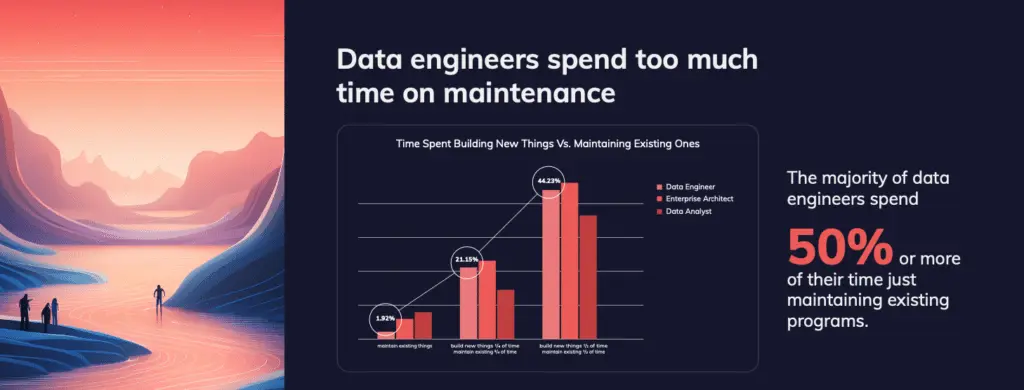
The majority of data engineers are currently spending 50% or more of their time just maintaining existing pipelines and programs (Ascend.io). With the average Senior Data Engineer in the U.S. commanding a salary of roughly $174,000 a year (Glassdoor), you are burning nearly $87,000 per engineer, per year, just to keep your custom pipelines from collapsing.
If you have a team of ten, that is nearly $1,000,000 in highly specialized salary wasted on infrastructure plumbing instead of building differentiated AI models.
The Gambill Differentiation Test
The availability of AI coding tools does not override the fundamental laws of enterprise strategy. At Gambill Data, we enforce a strict rule for our clients: Do not build what is merely configurable.
If an application or data integration does not encode your unique, proprietary competitive advantage, it is a commodity. You should never build a commodity, no matter how fast an AI agent can write the boilerplate.
Where Data Engineering Actually Belongs
To avoid creating an unmanageable data swamp, high-performing organizations must embrace a pragmatic, governed approach:
Buy the Commodity, but Own the Formats: License off-the-shelf tools for orchestration and observability. Let the vendor carry the maintenance liability. But, and this part is critical, never let that vendor dictate where or how you store your data. You must own the data layer in an open format (like Delta Lake or Apache Iceberg) to avoid trading coding liability for vendor lock-in.
Protect the Foundation (The “Yes, And” Strategy): Gartner notes that the monolithic “single source of truth” is dead; organizations are now forced to manage a “deluge of distrust” across purpose-built platforms. At Gambill Data, we solve this by combining the heavy engine of Databricks with the consumption layer of Microsoft Fabric. Because we leverage open standards, Databricks Unity Catalog can now natively read OneLake data. This centralized control plane handles the liability of access control, while Fabric offloads the liability of BI integration. We enforce strict architectural boundaries so they work together securely.
Build the Leverage: Unleash your data engineers to build exclusively on top of that governed foundation. Have them focus on complex data modeling, predictive algorithms, and high-value data products that directly impact the bottom line.
Build what makes you unique and drives your revenue. Buy what keeps your data flowing safely.
What Executives Must Ask
Before authorizing a custom internal build just because “AI makes the coding faster,” enterprise leaders must ask:
Are we building a strategic data asset, or are we just creating a web of unmanageable, custom pipelines to avoid a licensing fee?
Who owns the schema drift, data quality checks, and pipeline failures of this codebase in 36 months?
If the data engineers who prompted this code leave the company, can our remaining team actually maintain the architecture?
Is this custom build pulling our best data talent away from revenue-generating AI initiatives? Gartner predicts that by 2026, 60% of AI projects will be abandoned specifically because they are unsupported by AI-ready data. (And this is why you still need data engineers)
The companies that win in the AI era will not be the ones that wrote the most custom code. They will be the ones that recognized the difference between cheap code and expensive liability.
Stop letting AI hype dictate your data architecture. If your strategy is bogged down by internal builds of commodity tools, you are taking on massive, invisible liabilities. Gambill Data architects highly governed, reliable data ecosystems that reduce enterprise risk and drive measurable ROI. Stop guessing. Book a strategy call today.
Coming Next Week: Databricks AND Snowflake … Do we really have to choose?
Vendors want you to pick a side in the Databricks vs. Snowflake vs. Fabric war. We don’t. Next week, we break down why choosing “either/or” is an architectural trap, and how the highest-performing data organizations implement a hybrid model. Learn how to leverage the heavy engineering and unified governance of Databricks alongside the seamless consumption of Microsoft Fabric… without fracturing your Single Source of Truth.
Research & Data References
Apiiro (September 2025 & February 2026): Application security telemetry reporting a 322% jump in privilege escalation paths and 153% spike in architectural design flaws in AI-generated code.
Ascend.io (October 2023): DataAware Pulse Survey reporting the majority of data engineers spend 50% or more of their time maintaining existing programs.
Glassdoor (April 2026 Data): Salary benchmarking for Senior Data Engineers in the United States (Average: $173,939/year).
Gartner (Key Trends in Data and Analytics): Research noting the market has moved beyond the “single source of truth” toward managing a “deluge of distrust” across multi-platform estates.
Gartner (February 2025): Prediction that through 2026, 60% of AI projects will be abandoned due to a lack of AI-ready data and governance.
Microsoft Azure Blog (March 2026): Announcement of public preview for Azure Databricks Unity Catalog natively reading from Microsoft Fabric’s OneLake.
Related decision support
Data strategy consulting
Make platform and vendor tradeoffs from business priorities rather than a preferred product.
Review the service