
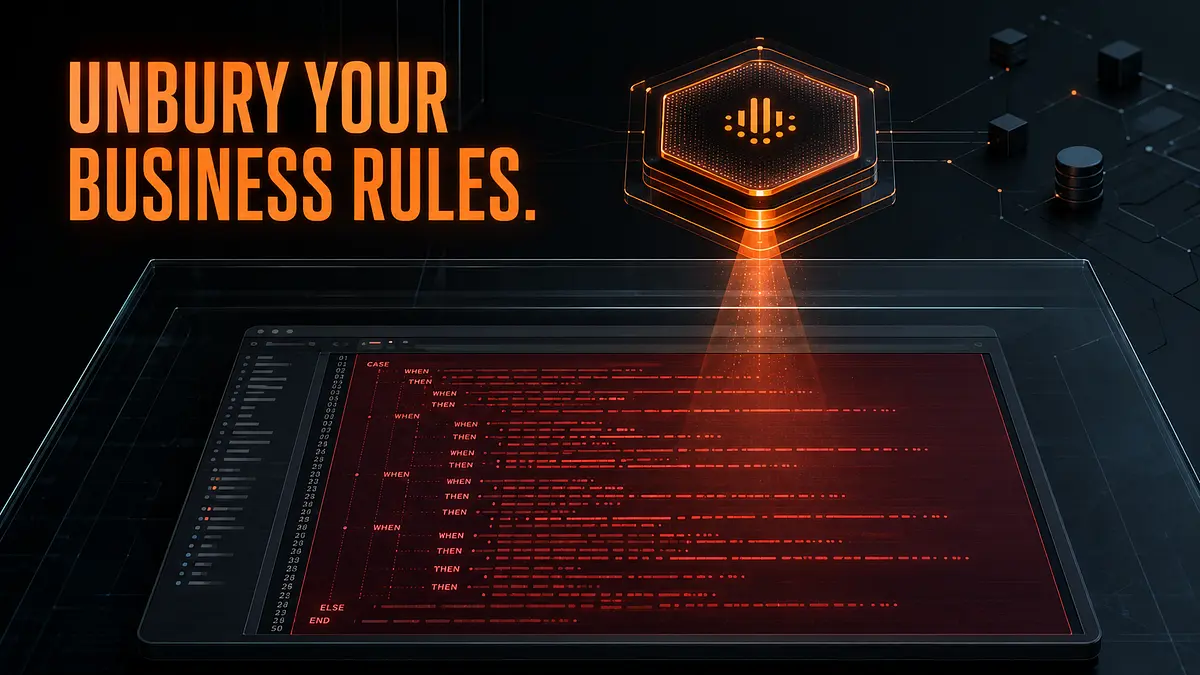
You’ve subconsciously spent the last three years building what you thought was job security. You buried critical business logic inside complex DAX measures, hidden Power BI report transformations, and custom SQL CASE WHEN blocks that only you understand. You felt indispensable. You were the team Oracle (not that one), the only person who knew where all the bodies were buried.
Then your CFO pushed the data team for direct AI query access using Copilot and Genie One. Because your data team reported to him, the request bypassed normal architectural scrutiny and went straight into production. Three weeks later, the room went cold in the boardroom.
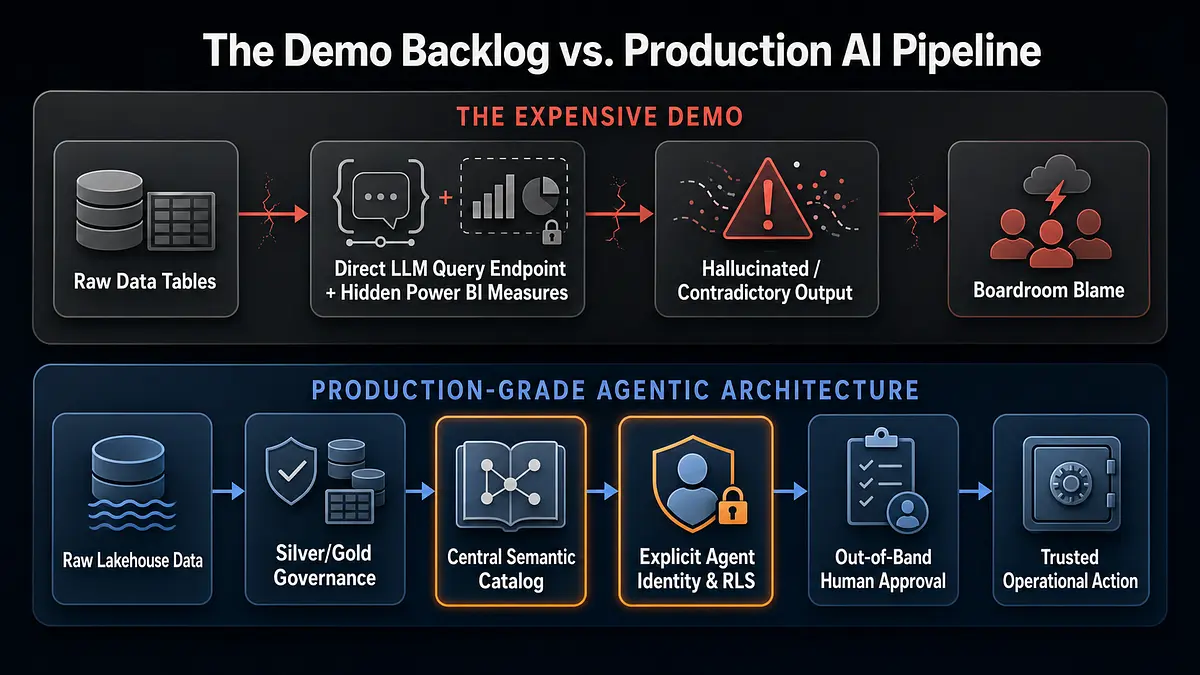
The CFO pulled up a revenue number in a chat window that flatly contradicted the official monthly financial report standing on the presentation screen. The executive team assumed the AI model was broken or hallucinating.
Who got called into the office to explain why the numbers didn’t match? You did.
The AI was performing exactly as designed. Your Power BI report was too. The problem was that your business logic was hidden inside a report file that the AI couldn’t see.
The AI wasn’t broken. Your architecture was.
Giving an AI tool direct access to a database without explicit context is like handing a junior the keys to the warehouse on their first day and expecting them to know which inventory is reserved, which is written off, and which is ready to ship. (And that they won’t drop a table in prod.)
When your data architecture is built on hidden logic, putting “AI-driven” in front of it simply creates a faster, more expensive pipeline to bad decisions.
The Hard Truth: The DAX Graveyard and Tribal Knowledge
For years, many data professionals have traded professional discipline for a false sense of security. As I broke down in The 10-Year Junior, hiding logic in GUI tools and unscripted dashboards creates a Tribal Knowledge Shield. It makes you feel like an Oracle, but it actually makes you un-hirable in a modern Code to Cash environment.
When a human analyst builds a finance report, they manually apply those unwritten rules. They know that “Active Customer” actually means a customer who made a purchase in the last 90 days, excluding internal test accounts, wholesale partners, and pending cancellations.
An AI model reading a raw table named customers doesn’t know any of that. It sees a column, performs a count, and hands executive leadership an answer that is technically correct based on the schema, but completely wrong based on business reality.
If your business logic lives in a dashboard measure, your AI is just guessing.
Even if your team built a Gold layer in your lakehouse, that is only half the battle. In The Medallion Masterclass, I broke down why Gold data is optimized for human consumption and standard BI queries. It is the storefront. But AI systems require an explicit ontology and machine-readable semantic context before you let your business loose on that data.
Without a documented, centralized context layer, you are asking a pattern-matching engine to infer years of institutional politics and unwritten edge cases from raw table names.
Who gets blamed when the numbers fail to match? You do.
The Architecture Fallacy: Prompts Are Not Security Boundaries
The lazy fix is always the same: write a longer system prompt. You try adding five paragraphs of rules to the prompt window, instructing the model to “always exclude test accounts when calculating revenue.”
That isn’t engineering. That is expensive wishful thinking.
Prompts guide intent. Identity, authorization, and platform architecture enforce boundaries.
When you expose an LLM or an agentic workflow to an ungoverned storage layer, you create massive operational risk. In the 2026 OWASP Top 10 for LLM Applications, they highlight excessive agency as a top-tier risk. The more authority you give an AI system to query databases, trigger API calls, and update CRM records, the more damage it causes when its context is flawed.
If an AI assistant executes an unauthorized query or leaks sensitive records, because row-level security was never configured at the lakehouse level, the model didn’t fail. You failed to build a production-grade boundary.
A vector database sitting completely outside your retention, deletion, and auditing policies isn’t an AI innovation (yes, including that vector store your team spun up last month). It is just technical debt with an API endpoint.
The AI Context & Readiness Protocol
Before you write another line of code or attempt to connect an LLM to your production database, you must audit the system surrounding the model. Stop treating governance as a final review step and start building it directly into your execution layer.
This four-step protocol establishes the minimum engineering controls required before moving an AI system into production.
Unbury Logic from the Presentation Layer
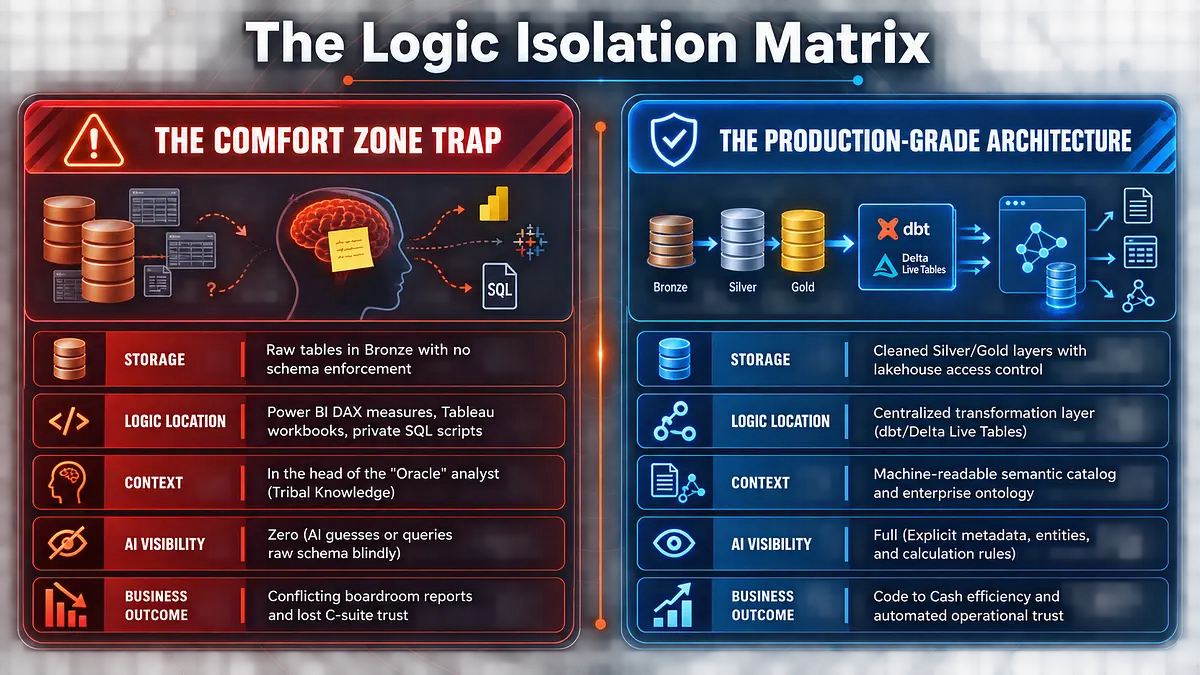
Extract business rules, calculated measures, and conditional logic out of Power BI reports, Tableau workbooks, and scattered SQL scripts. Centralize those definitions inside your transformation layer (such as dbt or Delta Live Tables) so that human analysts and AI models query the exact same underlying logic.
Build a Machine-Readable Enterprise Ontology
Document your core business entities, relationships, and metrics in a centralized semantic catalog. Provide the AI with explicit metadata regarding table definitions, authoritative sources, metric calculations, and deprecated columns before allowing it to generate SQL queries.
Isolate Agent Identities and Enforce Storage-Level Security Never allow an AI agent to operate through a shared service account or inherit a developer’s elevated permissions (yes, even if the request came directly from the CFO). Assign every production agent its own explicit identity, and enforce row-level and column-level access controls at the lakehouse layer before data reaches the model.
Implement Full-Stack Traceability and Kill Switches
Build observability pipelines that log prompt versions, retrieved source lineage, model parameters, API payload destinations, and explicit user approvals. Provide an immediate operational kill switch that revokes an agent’s credentials and disables its execution paths instantly if anomalous behavior is detected.
What every step in this protocol has in common is simple: it forces you to stop acting like a GUI operator relying on tribal knowledge and start acting like an Architect who builds production-grade data assets.
Political and Financial Stakes
“Your data is broken”. These words should strike fear that your career is immediately in danger. Data quality is blame management. When an executive gets embarrassing numbers in a board meeting, they don’t fire the AI vendor. They look for the data engineer who built the pipeline.
Furthermore, regulatory enforcement is no longer a theoretical debate. The EU AI Act became broadly applicable on August 2, 2026. For organizations within its scope, requirements around system documentation, data quality, human oversight, and continuous monitoring are active legal obligations.
Existing regulatory frameworks apply just as aggressively. Data privacy laws, industry security standards, and consumer protection mandates don’t disappear because an output was generated by an LLM.
The FTC has explicitly warned model providers and commercial enterprises that claims regarding privacy, confidentiality, and data usage will be strictly enforced.
Putting “AI-powered” in front of an ungoverned database doesn’t create a technical or compliance exemption. It just builds a faster, more expensive pipeline to bad decisions.
Gambill Insight
Stop hiding behind the Tribal Knowledge Shield. Stop relying on DAX measures as a substitute for real data modeling.
The Comfort Zone feels safe because you are the only one who can navigate the mess you created. But in a production environment where businesses demand autonomous systems, that mess makes you a liability.
Stop being the “Oracle” (still not that Oracle). Start being the Architect.
Are you a veteran engineer feeling the walls of the Comfort Zone closing in?
Don’t wait for a boardroom crisis or a layoff to wake you up. Join the Gambill Data Coaching Program. We don’t do happy-path tutorials; we teach you how to build production-grade architectures that survive real-world security and data audits.
Want to test your current architecture before a hiring manager or CFO tears it down? Check out the Gambill Portfolio Project Generator and build systems that prove Code to Cash.
Join the Gambill Data Coaching Program
Subscribe on YouTube for weekly production architectural breakdowns!
Related decision support
AI readiness assessment
Test whether data, governance, ownership, and operating controls can support responsible AI use.
Review the service