
Most people assume a 26-year career in data starts with a Computer Science degree. Mine started with a Brillo pad and a “rude awakening.”
For those of you who have recently joined me here, I wanted to introduce myself and share the “why” behind Gambill Data. My path wasn’t linear, it was forged in high-pressure environments where “close enough” was never an option.
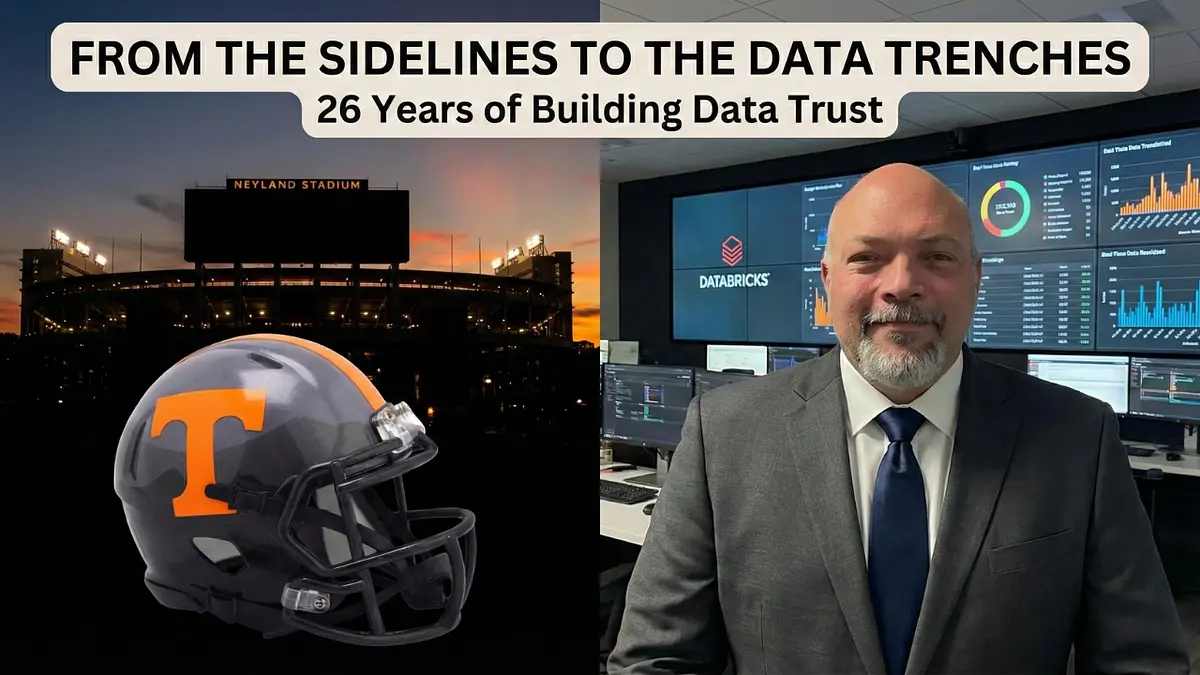
The Standard: Lessons from the Helmet Scrub
From 1997 through 1999, I was a student manager for the University of Tennessee football team. I was a Sports Management major, living and breathing the game. But “living the game” wasn’t just standing on the sidelines; it was the grueling, meticulous work of the “Helmet Scrub.”
As this WBIR vault footage shows, being a manager was a reality check. We spent five to six hours every week with pressure hoses and Brillo pads, scrubbing every scuff off those helmets. Why? Because on Saturday, we were on national TV. If a helmet didn’t pass inspection, it went back to the start. The standard was perfection.
[Video: that is a much younger me…]
By the end of the 1999 season, I realized I wanted to apply that same discipline to business. I left the stadium, entered the workforce, and landed in Customer Service.
The Brutal Truth: Chaos Doesn’t Scale
Coming from the disciplined world of SEC football, corporate inefficiency was a shock. Data was siloed, reports were manual, and decisions were made on “gut feelings.”
Then came Sarbanes-Oxley. Suddenly, my team was tasked with reviewing thousands of customer adjustments. Every week, we were handed literal reams of paper, forests worth of documentation, to review and sign off on manually.
I didn’t see a “data problem.” I saw a massive operational failure.
The First “Gambill” Solution
I wasn’t hired as a developer, but I couldn’t sit through the inefficiency. I taught myself the stack of the day and performed a different kind of “helmet scrub” on our business data:
I hunted down source systems and pulled data into a SQL Server under my desk.
I built a VB.NET frontend to digitize the documentation process.
I automated the output using Crystal Reports.
The tools are now 26+ years old, but the result was modern: We moved from “burning forests” to a digital Single Source of Truth.
The business realized they didn’t need a customer service rep; they needed a “data guy.” From there, my career took off, leading me through roles as an IC, a consultant, and even the Director of Data & Analytics for a major cybersecurity organization.
For a time, one group I worked with fondly referred to me as “Fix It, Gambill.” And that is exactly what I did. I came in and made their data work for them instead of against them.
The Mission Today
Today, the stakes are higher, and the tools are more sophisticated. At Gambill Data, we’ve traded that under-the-desk SQL server for enterprise-grade Databricks Lakehouses and governed Microsoft Fabric environments.
But the core philosophy hasn’t changed in 26 years: We don’t just build pipelines; we build data assets that the business can trust.
In the data world, everyone wants to talk about the “National TV” moments, the AI and the shiny dashboards. But I’m here because I know how to do the “Helmet Scrub.” I know that if your data isn’t clean, governed, and reliable, the rest of the show doesn’t matter.
I’m glad you’re here for the journey.
Stop guessing. Let’s build something reliable.
P.S. Want to see this philosophy in action? If you are tired of the theory and want to see how we apply the "Helmet Scrub" standard to modern enterprise architecture, I’ll be hosting a Databricks Workshop at DataTune in Nashville on March 6th. We’ll be doing a deep dive into building data assets that scale. If you're in the area, I’d love to shake your hand and talk shop.