Most data projects fail because they focus on tools, not trust. The current AI hype cycle is proving this once again.
Leaders are purchasing enterprise licenses for Claude, Cursor or ChatGPT, expecting a massive surge in data engineering velocity. Yet, pipelines are still failing, technical debt is rising, and delivery timelines remain stagnant.
Why? Because writing syntax isn’t the hard part of data engineering. We had stack overflow before, and Claude is kinder… The context is the hard part.
A generic AI agent doesn’t know your schemas. It doesn’t know your Personally Identifiable Information (PII) handling rules. It doesn’t understand your CI/CD deployment standards. When you ask it to build a pipeline, it guesses. And in enterprise data architecture, guessing introduces tech debt and catastrophic risk.
If you want AI to actually deliver ROI for your data engineering teams, you must stop treating it like a glorified autocomplete and start architecting AI Agent Skills.
What Are AI Agent “Skills”?
In the context of data engineering, a “Skill” is a programmatic integration that grants an AI agent secure, governed access to your enterprise’s architectural context. It is the bridge between a Large Language Model’s reasoning capabilities and your single source of truth.
Without these skills, agents hallucinate logic. With them, agents architect reliable pipelines.
To transform an AI agent into a trusted asset, we require three foundational skills:
1. Metadata Mastery (The Unity Catalog Skill)
An agent cannot write a reliable transformation if it is blind to the source data.
What it is: A skill that allows the agent to securely query your data catalog (specifically, Databricks Unity Catalog or Microsoft Fabric OneLake) to retrieve table schemas, column descriptions, and lineage metadata before writing a single line of code.
Why we include it: It eliminates schema hallucination. When an engineer asks the agent to “join the customer and transaction tables,” the agent shouldn’t invent column names. It should pull the exact schema from Unity Catalog, ensuring the resulting SQL or PySpark is instantly runnable and accurate.
2. Governance and Quality Enforcement (The Data Contract Skill)
Code that moves data is worthless if the data itself is garbage.
What it is: A skill that feeds your enterprise’s specific data quality standards and PII hashing rules directly into the agent’s context window.
Why we include it: Generic AI defaults to naive data movement. A skilled agent, guided by Gambill Data standards, knows that every pipeline must include data quality checks. When instructed to build a silver-layer table, the agent will automatically implement expectations (like non-null constraints or anomaly detection) because the “Skill” dictates that a pipeline without governance is an incomplete pipeline.
3. Production Deployment Awareness (The Infrastructure Skill)
We do not build loose notebooks; we architect scalable infrastructure.
What it is: A skill that trains the agent on your specific deployment framework. Instead of outputting isolated scripts, the agent outputs Databricks Asset Bundles (DABs) or CI/CD-ready YAML files.
Why we include it: Engineers waste hours translating AI-generated code into production-ready infrastructure. By giving the agent the “Deployment Skill,” you ensure that the output adheres to your strict CI/CD pipelines, significantly reducing the friction between development and production.
The Anatomy of an AI Data Agent Skill Tree
So, what does this look like in practice? You don’t just tell an AI to “be governed.” You have to programmatically inject your operating model into the agent’s reasoning engine.
At Gambill Data, when we architect an AI agent for a client, we build a dedicated repository—a literal “Skill Tree”—that acts as the agent’s brain, rulebook, and testing ground.
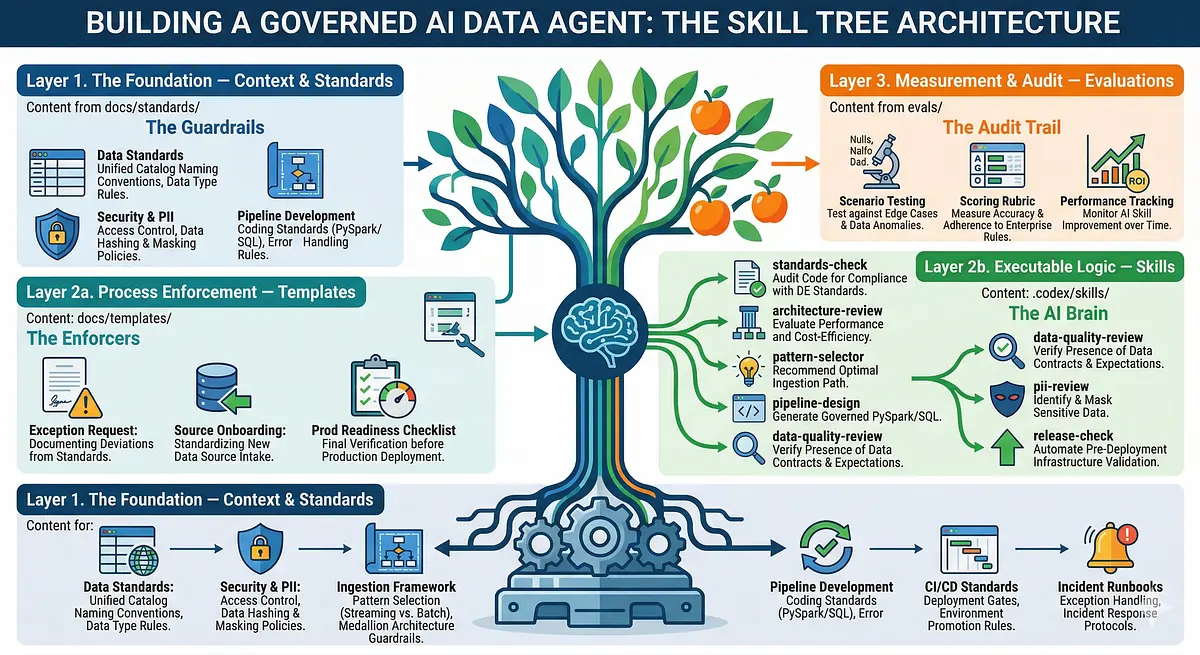
Here is the reference architecture for a production-grade Data Engineering AI Agent:
data-engineering-skill/
├─ AGENTS.md
├─ README.md
├─ plans/
│  ├─ build-skill-plan.md
│  ├─ implement.md
│  └─ documentation.md
├─ docs/
│  ├─ standards/
│  │  ├─ databricks-data-engineering-standards.md
│  │  ├─ platform-architecture-guardrails.md
│  │  ├─ security-and-pii-policy.md
│  │  ├─ ingestion-decision-framework.md
│  │  ├─ pipeline-development-standard.md
│  │  ├─ data-quality-and-testing-playbook.md
│  │  ├─ cicd-and-deployment-standard.md
│  │  ├─ metadata-lineage-and-documentation-standard.md
│  │  ├─ exception-and-architecture-review-policy.md
│  │  ├─ incident-response-and-runbook-standard.md
│  │  └─ ai-agent-guardrails.md
│  └─ templates/
│     ├─ exception-request-template.md
│     ├─ source-onboarding-template.md
│     ├─ runbook-template.md
│     └─ production-readiness-checklist.md
├─ .codex/
│  └─ skills/
│     ├─ de-standards/
│     ├─ de-architecture-review/
│     ├─ de-ingestion-pattern-selector/
│     ├─ de-pipeline-design/
│     ├─ de-data-quality-review/
│     ├─ de-security-pii-review/
│     ├─ de-cicd-release-check/
│     └─ de-pr-summary/
└─ evals/
├─ scenarios/
└─ rubric.md
If you look closely at this structure, you will notice it mirrors a highly disciplined engineering team. Here is why each section is critical to achieving ROI:
docs/standards/(The Guardrails): This is your enterprise memory. Generic AI defaults to the easiest path, which is rarely the right path. By feeding the agent explicit standards, you prevent it from suggesting anti-patterns. If the agent doesn’t know your ingestion framework, it will recommend batch processing when your business requires streaming.docs/templates/(The Enforcers): Agents are exceptional at filling out structured data. By providing templates, you ensure that every new pipeline generated by the AI comes with a completed runbook and a production-readiness checklist. This forces the AI to output complete, governed solutions, not just naked code..codex/skills/(The Executable Logic): This is where theory becomes action. These are the specific, callable capabilities the agent can execute. Instead of a generic prompt, an engineer can triggerde-security-pii-reviewto have the agent audit a pull request specifically for data leakage.evals/(The Audit Trail): You would never deploy a data pipeline without automated testing. Why would you deploy an AI agent without it? Theevalsdirectory contains the rubrics and scenarios used to score the agent’s performance before it is allowed to assist your developers.
The Pragmatic Approach: Start Where You Are
Looking at that tree can be intimidating. You might be thinking, “We don’t even have a documented CI/CD standard yet, let alone an AI guardrail policy.”
That is okay.
At Gambill Data, we operate in reality. You do not need absolute maturity to start seeing ROI from governed AI. Do not let “perfect” become the enemy of “better.”
If your organization is earlier in its data maturity journey, treat this skill tree as a roadmap, not a prerequisite. Fill in the standards you do have. Start with the absolute critical risks: draft a basic security-and-pii-policy.md and an ingestion-decision-framework.md. Give the AI agent just those two skills to start.
As your team matures, as you adopt Unity Catalog, and as you define stricter data contracts, you simply add those documents to the repository. The AI agent grows up right alongside your data organization.
We don’t just build pipelines; we build data assets that the business can trust. The goal isn’t to build all of this overnight. The goal is to build a foundational structure that stops your AI from guessing, immediately reduces your tech debt, and establishes a single source of truth for pipeline development.
Are your AI agents guessing or architecting?
Before you deploy another Copilot license to your engineering team, you need to ensure your guardrails are in place.
Let’s Connect This Week at CodeStock
If you are attending CodeStock in Knoxville this Thursday and Friday (April 9th & 10th), I’d love to connect in person. Stop guessing on your data strategy and come see me outline exactly how we are solving these problems on the ground.
I will be leading two sessions:
Thursday, April 9th: Adapt or Be Automated: Continuous Learning in The Age of AI for Data Engineers
Friday, April 10th: Modern Data Engineering With Databricks: Lakeflow, DABs and Orchestration
Drop by my sessions or find me in the halls to talk data architecture, AI integration, and how to start building reliable assets. See you there!
Data Engineering’s Brutal Truth: The 2026 Job Market This deep dive on the current realities of the data job market perfectly highlights why engineers must adopt these strategic AI skills to stay relevant and avoid being replaced by automated tools.